Insightful analysis and engaging commentary on political, economic and general sustainability issues
Author: Dr. George Asiamah
Dr. George Asiamah is a prolific writer and researcher with a special interest in sustainability governance. With a keen eye on the dynamics of politics and economies, Dr. Asiamah provides in-depth analysis and thought-provoking commentary on these critical areas. His work encompasses a broad spectrum of topics, including the political and economic landscapes of Ghana, the broader African continent, and the global stage.
Beyond his analytical prowess, Dr. Asiamah is also an imaginative writer. He crafts compelling narratives that transport readers to new worlds, exploring the boundless realms of human imagination. His fiction writing serves as a creative outlet, offering a refreshing counterbalance to his scholarly pursuits.
Through his writings, Dr. George Asiamah aims to foster a deeper understanding of the world, promote sustainable practices, and inspire readers to think critically about the issues that shape our present and future. Whether delving into the complexities of global political economy or weaving intricate tales of fiction, Dr. Asiamah's work is a testament to his dedication to knowledge, creativity, and sustainability.
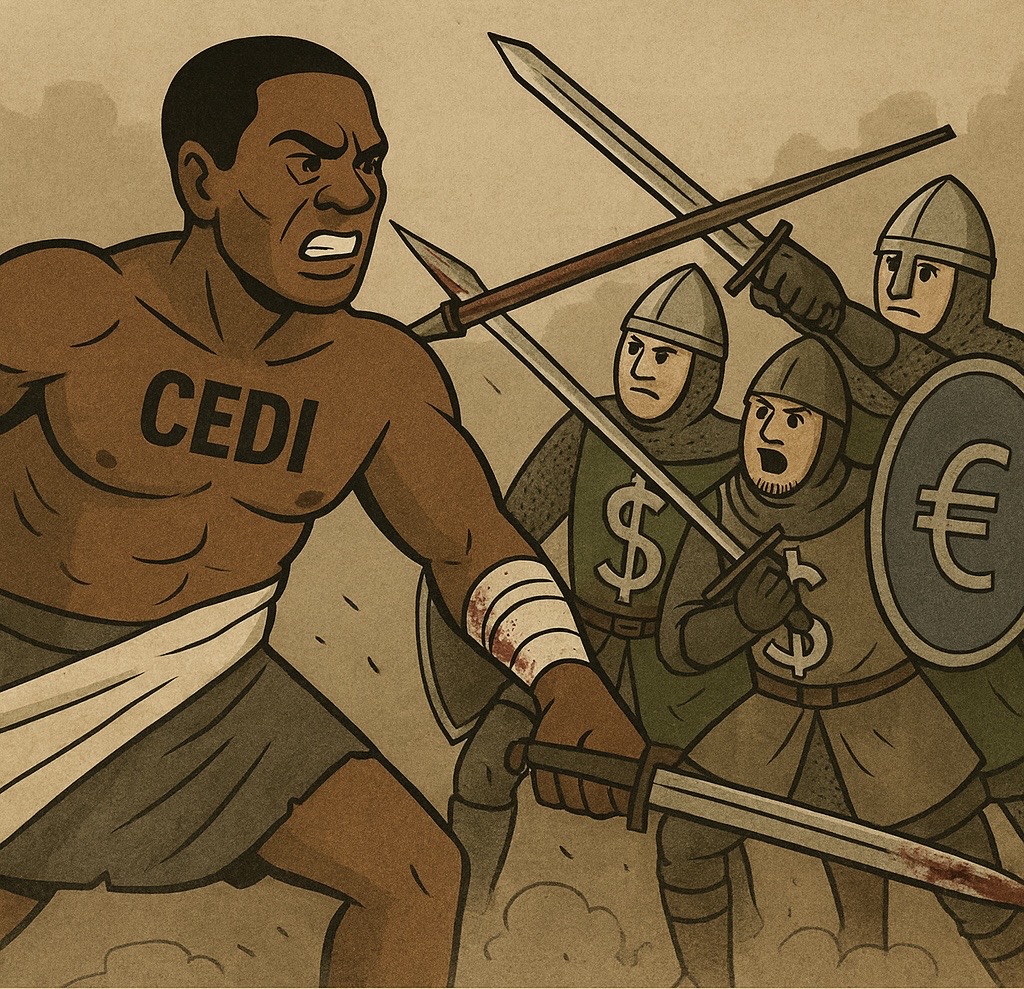
The drums of Agyakrom Arena rolled, and the crowd gathered. In the red corner stood Cedi, the wiry fighter of the land. He wasn’t the tallest, nor the strongest, but he carried cocoa in his fists, gold in his teeth, and oil dripping down his back. The people chanted his name, believing their warrior could at last tame the mighty giants.
Behind him stood his commander, the NPP Marshal, decorated not with medals but with slogans stitched into his uniform: “Battle-Tested Plan,” “Dr. Fundamentals,” “One District, One Factory.” His sword gleamed with promises; his shield shone with borrowed optimism.
“Forward, Cedi!” the marshal shouted. “This is your destiny.”
But the battle was no village wrestling contest. Across the arena, three giants lumbered forward: Dollar, broad-chested, carrying oil barrels in one hand and global invoices in the other. Pound, dressed like a retired colonial officer, cane tucked under his arm, school-fee receipts in his pocket. Euro, tall, sleek, marching in formation with twenty-seven foot soldiers holding briefcases of regulations, machinery, and pharmaceuticals.
The whistle blew.
Dollar swung first, a heavy punch from crude oil imports. Cedi staggered. Pound jabbed with spare parts and tuition fees, cracking his ribs. Euro didn’t shout; he suffocated him quietly with wheat, vaccines, and machinery. The crowd gasped as Cedi stumbled, his shield splintered, his armour cracked.
“Hold the line!” the marshal cried. But the line broke. Cedi fell face-first in the dust, groaning, the flag of Agyakrom trampled beneath him.
The people looked at each other in silence. The trotro mate muttered: “So, this is the plan?” A Makola trader shook her head: “Even my tomatoes are ashamed.”
The giants didn’t even boast; they simply stood over him, as if to say: “This is what happens when you enter the ring unprepared.”
Proverb
“Sɛ nsuyire ba a, ɛna yɛhu deɛ ne kodoɔ yɛ papa.” (When the floods come, we see the quality of the canoe.)
Policy Reflection
When global storms hit – rising oil prices, higher imports, currency shocks – Cedi revealed what had long been hidden: an economy built on weak planks. The canoe had been painted with slogans, but its wood was cracked. Imports outpaced exports, debts outpaced revenues, and buffers were too thin to weather the current.
In the flood of global markets, you do not rise by chanting; you rise by building a canoe that floats.
Long before the drums beat at Agyakrom Arena, the fate of Cedi was already whispered in chop bars, lorry parks, and Parliament corridors.
Cedi was no ordinary fighter. He was born in 1965, young and ambitious, wrapped in national pride like kente on Independence Day. At birth, he carried cocoa in one hand, gold in the other, and oil hidden beneath his skin. His parents promised him glory: “You will stand tall among the giants. You will not beg; you will command.”
But the world is not a fair marketplace. The giants – Dollar, Pound, and Euro – had been in the ring for centuries, bulging with the muscles of empire, trade, and industry. They had their networks, their soldiers, their standards, their debts. They did not just fight with fists; they fought with memories.
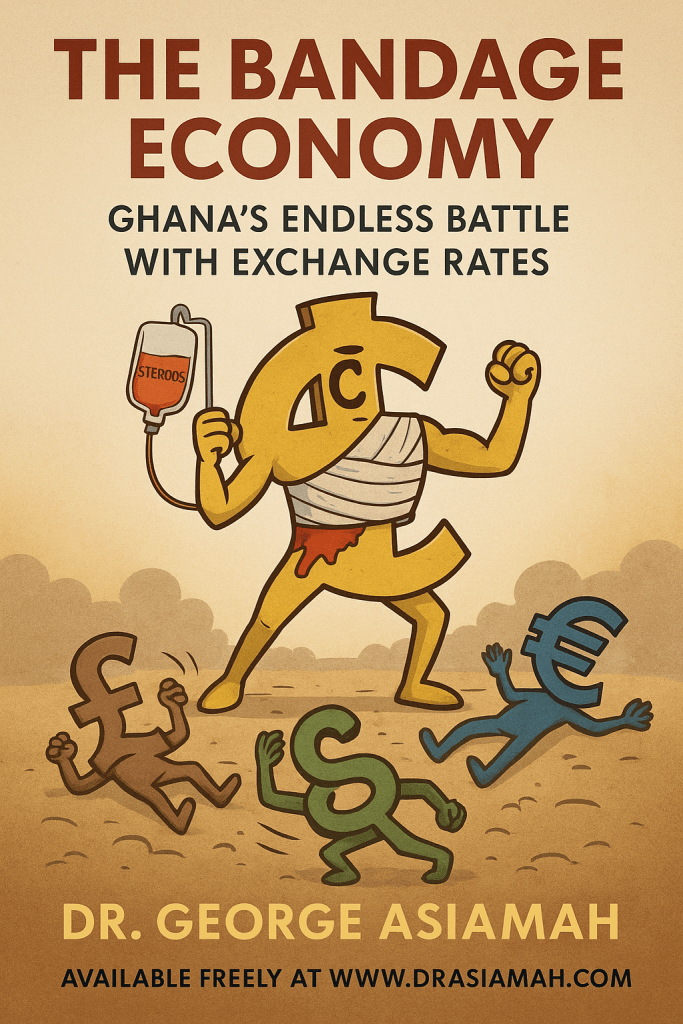
Cedi grew up in this world, always smaller, always hustling. Sometimes he rose with swagger, sometimes he fell with shame. He had seen coups and slogans, IMF infusions and debt write-offs, promises and disappointments. He had been bandaged, boosted, and broken more times than the crowd could count.
Yet the people of Agyakrom never gave up on him. Every election, they dressed him in a new uniform, gave him a new commander, and shouted, “This time, he will conquer!” The crowd’s memory was short, but their hope was long.
The arena itself was merciless. Every import, every school fee, every litre of fuel was another punch. Every cocoa harvest, every gold sale, every donor inflow was another jab back. Victories were rare, defeats were common, but the spectacle never ended.
The elders said:
“Sɛ anomaa anntu a, ɔbuada.” (If the bird does not fly, it starves.)
Cedi might never soar like Dollar or Pound, but he had to perch somewhere sturdy – or risk falling forever.
This is the story of Cedi: a fighter wounded and revived, mocked and applauded, sprinting on borrowed steroids, and finally learning that his survival depends not on miracles but on habits. It is the story of Ghana’s economy, told in the dust and sweat of a ring where applause is loud but stomachs are louder.
The battle of Cedi is not just about exchange rates; it is about identity, resilience, and the stubborn hope of a people who refuse to stop cheering, even when their pockets are empty.
And so, the drums beat again. The giants tighten their gloves. The medics prepare their syringes. The Old Wise Man sharpens his proverbs. And the crowd leans forward, asking the eternal question:
“When the drums of freedom beat, even the slowest beast begins to dance.”
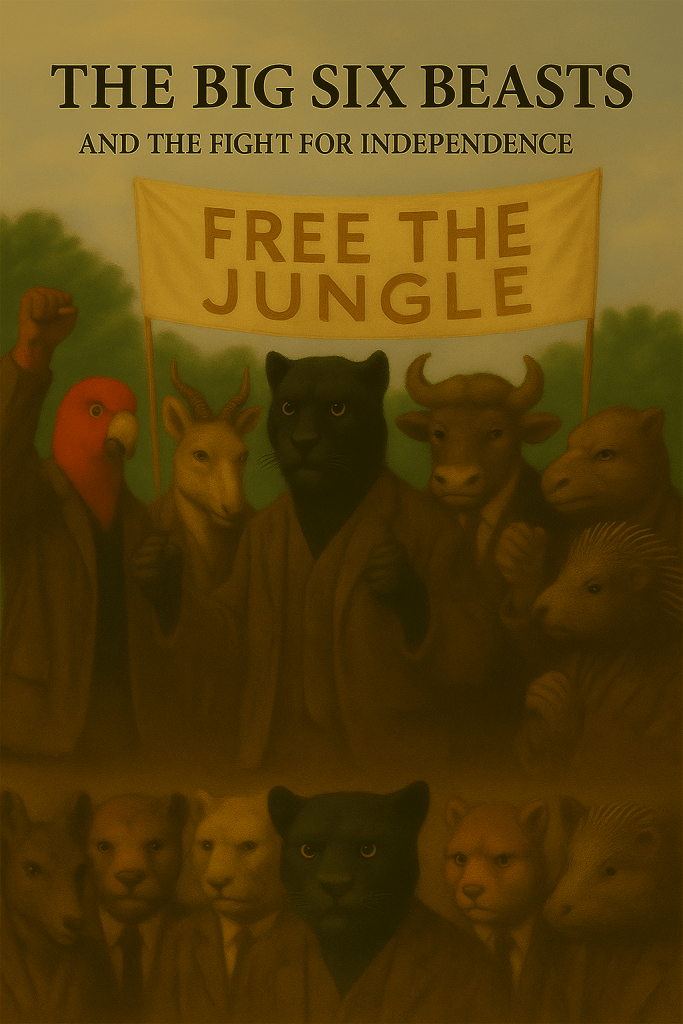
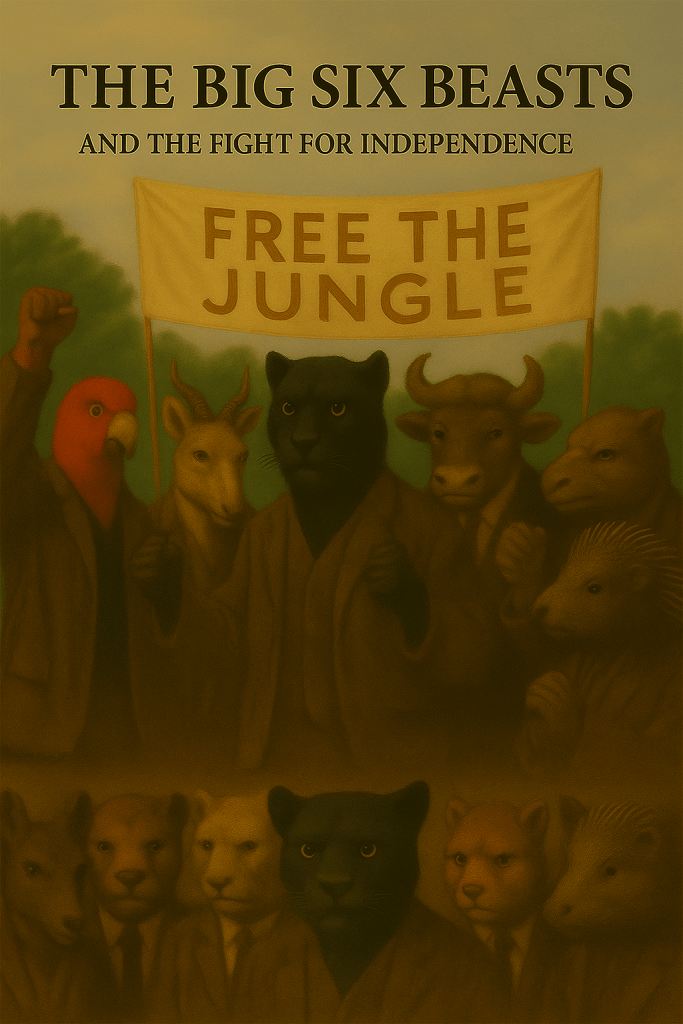
By the early 20th century, young beasts in Agyakrom demanded answers. Beasts who read the colonial scrolls and saw the hypocrisy. Beasts who had drunk both palm wine and European philosophy. Beasts who demanded a Free Jungle.
One of them stood tall.
He was fast. He was fierce. He was relentless.
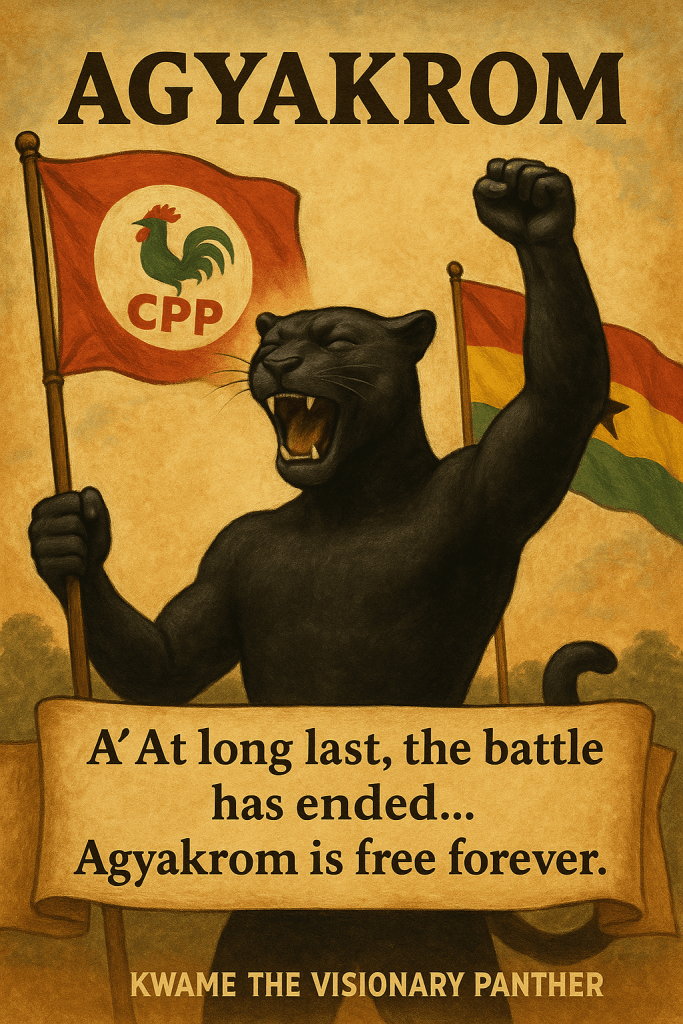
His name? Kwame the Visionary Panther.
Not born into wealth. Not descended from chieftain trees. But his speed was unmatched – both in thought and in speech.
He returned from the icy forests of foreign lands with a tail full of socialist theories, a mane full of Pan-African dreams, and a scroll titled “Positive Action.”
The UGCC and the Great Split
Before the Panther returned to Agyakrom, there existed a cautious committee of beasts known as the United Grove for Common Creatures (UGCC). Composed of owls, elder elephants, scholarly squirrels, and coconut-sipping lawyers, this elite circle wanted the colonial zookeeper gone – but politely. Through letters. Through procedures. Through distant petitions and gentlemanly growls.
They needed a spark. A beast with a voice that could rally the groundlings, not just the treehouse elites.
So they summoned the Panther – fresh from foreign groves, fire in his bones, socialism on his breath. Educated in the books of faraway lands, but burning with the fury of local injustice, the Panther spoke not like a bureaucrat, but like a prophet.
At first, he served them dutifully – the UGCC’s roarer-in-chief. But soon, friction brewed. The Panther moved too fast. Dreamed too loud. Called for immediate freedom, while the elders still debated resolutions.
He was bold. They were cautious.
He roared: “Self-rule now! Not next year, not when approved by colonial tail-waggers. Now!”
And so he broke off. He formed his own rebel camp. He built the Crop Protection Party (CPP) – a movement not of parchment and protocol, but of farmers, fisher-beasts, and furious youth.
He mobilised monkeys in the markets, drummers in the bush, cocoa porters, cassava vendors, and even the goats who had never been counted in jungle censuses.
Positive Action and the Beast Awakening
Under the Panther’s call, the jungle stirred. Farmers refused to send cocoa to colonial depots. Teachers marched out of classrooms. Market mamas sang protest songs at dawn. Young cubs – who once only fetched water and memorised empire poems – began distributing leaflets and climbing platform trees to speak.
The colonial gatherers and zookeepers panicked. They arrested the Panther.
But that only made him a martyr.
While he sat in silence, his name echoed through the vines. His image spread across banana leaflets. His supporters, fierce and loyal, would not rest.
“Free the Panther!” “The jungle must be ours!” “Down with the Bulldog Empire!”
The Election That Changed the Jungle
In 1951, the hunters and the gatherers – realising the jungle’s heat could no longer be managed with cold treaties – organised an election.
The Panther ran from his prison cell.
And he won.
Landslide.
The message was clear: the jungle no longer wanted caretakers in suits.
It wanted leaders who ran with the people.
The Independent Jungle
Right from the start, the Panther did not rest. He dreamt big. Lived large. Built fast.
Banana factories. Coconut oil refineries. Cashew trains stretching across canopy corridors. He constructed cocoa processing hubs. He summoned engineers to build the mighty Volta Dam, a monument to modernity that promised power for all. The Black Star shipping fleet roamed the seas.
He didn’t stop at infrastructure. He wrote books. He launched five-year plans. He gave speeches that turned parrots into philosophers and squirrels into citizens.
African beasts across the continent looked to Agyakrom and said: “If they can run free, so can we.”
The Panther became not just a leader, but a symbol.
His dreams were continental. He envisioned a Union of Forest States. He funded liberation struggles in neighbouring groves. He hosted pan-jungle conferences where beasts debated unity in twenty dialects.
To the West, he was dangerous. To the oppressed, he was divine.
He welcomed revolutionaries. He built a new capital. He preached unity.
He declared:
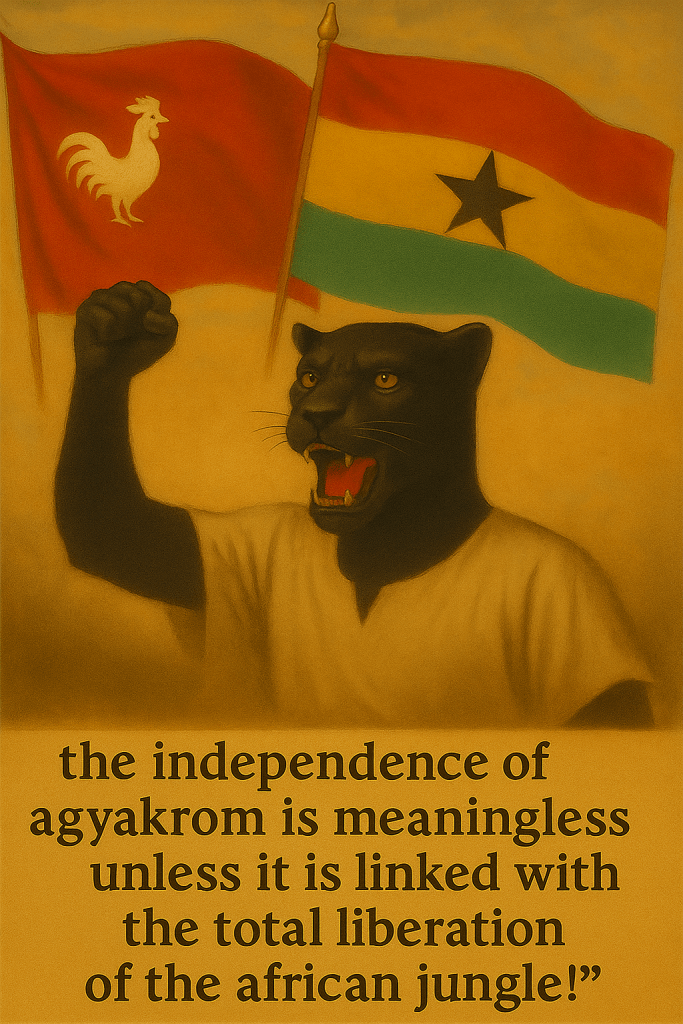
“The independence of Agyakrom is meaningless unless it is linked with the total liberation of the African jungle!”
But…
JUNGLE WISDOM OF THE DAY
“When the chains fall off the paws, the mind must still unlearn the leash.”
Every jungle has a history. But not every beast remembers.
Long before thrones, ballots, slogans, and scandals, there was a vast land in the western belly of the African continent – a place of gold, rivers, thick forests, and proud beasts.
They called it Agyakrom.
It was not yet a republic.
It was not yet even a country.
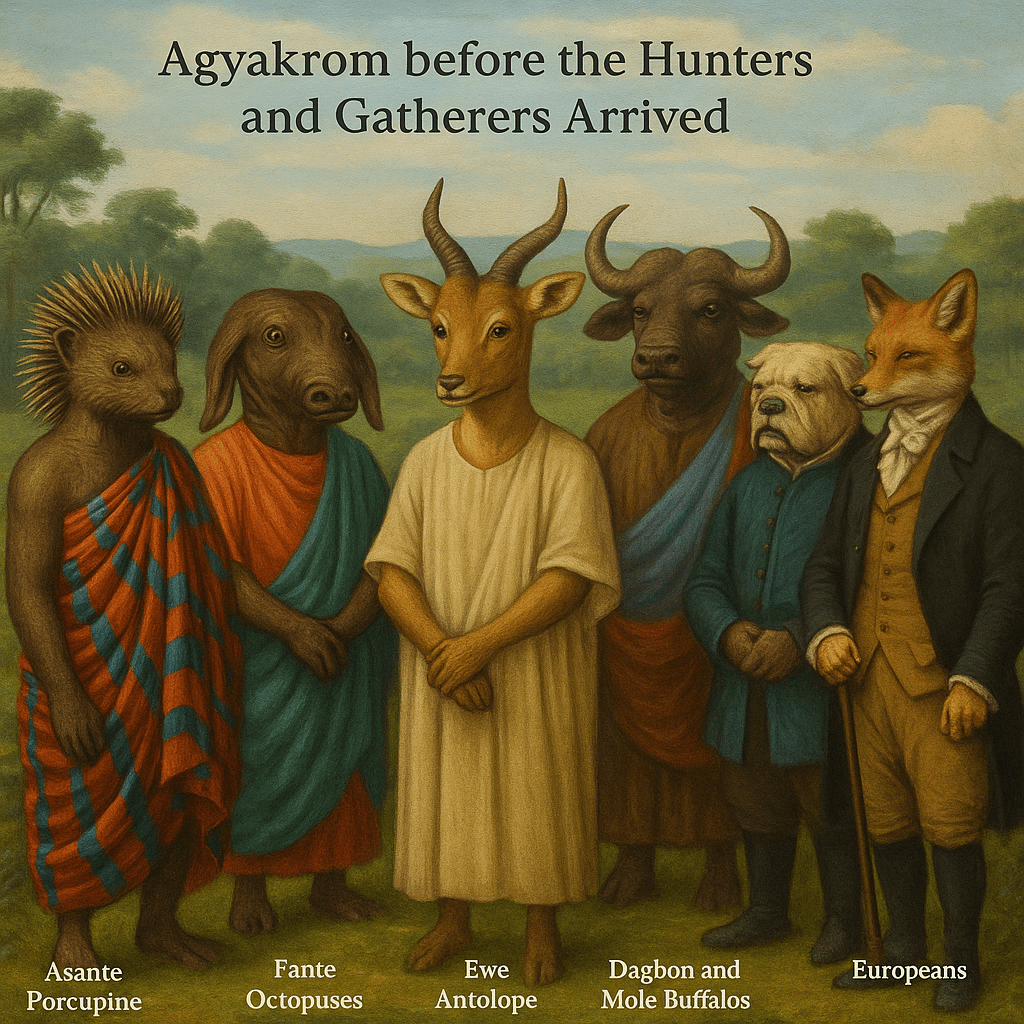
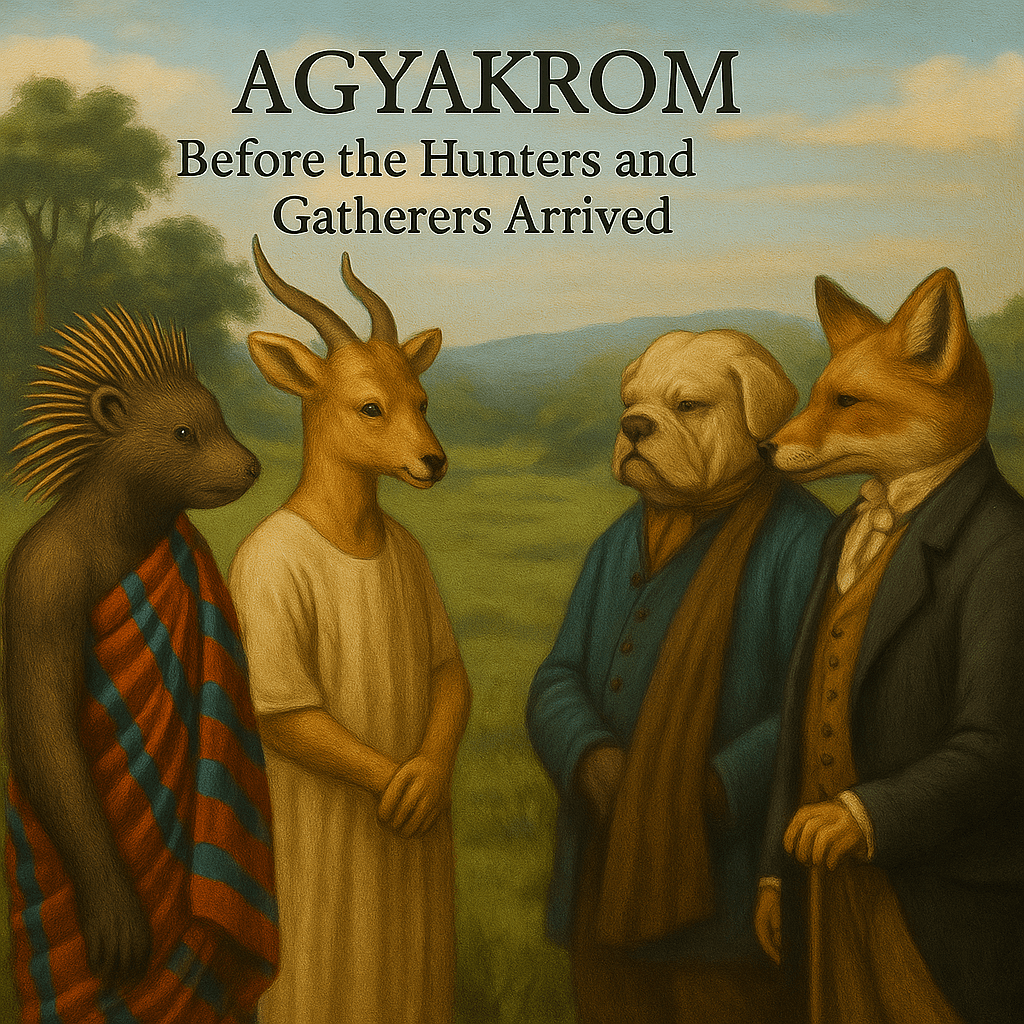
It was a patchwork of powerful animal clans – Asante Porcupines, Ewe Antelopes, Mole-Dagbani Buffalos, Fante Octopuses, Ga jackals, and many more – each with their own kings, traditions, markets, shrines, and seasonal drumbeats.
They lived not in utopia, but in order.
The rivers flowed with rhythm.
The forests echoed with proverbs.
The elders ruled with stools, not scrolls.
And then – the hunters came.
The Coming of the Hunters and Gatherers
No one knows exactly when the first Hunter ship hit the shores. But the river whispers tell of the time when strange, light-skinned creatures – two-legged, clothed in iron and greed – arrived with crosses, coins, and chains.
They came bearing gifts: mirrors, rum, muskets, and the Holy Scroll.
But beneath their cloaks were ledgers.
The jungle called them The Gatherers.
Because that’s what they did.
They gathered:
• Gold from the Lion caves,
• Ivory from the forest bones,
• Palm oil from the Monkey Groves,
• And worst of all, beasts themselves – from the weakest cubs to the strongest buffaloes.
They said they had come to civilise.
But civilisation came with shackles.
For over three hundred rainy seasons, Agyakrom watched its children carried across oceans.
And when the chains were finally lifted, the Gatherers returned – not with whips, but with Rule.
The Jungle Becomes a Colony
They called it a protectorate.
Then a colony.
Then a gold coast – not because of the coast, but because of the gold.
They drew borders like scratch marks on a termite map.
They made laws in languages no beast spoke.
They crowned chiefs they could control.
They introduced currency, courts, and new religion – leaving confusion and conversion in equal measure.
The Jungle Parliament? Replaced by District Commissions.
The beast customs? Replaced by colonial codes.
The jungle’s soul? Traded for infrastructure and flags.
Agyakrom, the free land of many tribes, became a colony.
And the beasts began to forget they were once sovereign.
But as every wise monkey knows:
You can cage a lion, but you cannot silence the growl forever.
The Rise of the Roaring Beasts
By the early 20th century, the jungle began to stir.
Young beasts – some educated abroad, some trained in the colonial classrooms, others shaped by the fireside wisdom of their elders – began to ask dangerous questions.
“Why must we fetch water for their baths while our rivers run dry?”
“Why must our cocoa feed their children, but not ours?”
The great independence struggle was born.
JUNGLE WISDOM OF THE DAY
A Beast that forgets where it came from will never know where it is going
Watch Out for Episode 2: The Struggle for Independence
On 4 June 2025, Ghana’s Parliament passed a controversial bill introducing a one-cedi per litre levy on petroleum products – framed as a necessary intervention to address the ever-growing debt in the energy sector and, ultimately, to end the country’s lingering electricity supply challenges, popularly known as “dumsor.” The ruling NDC government justified the move by pointing fingers at the mismanagement of the previous administration, suggesting that the Energy Sector Recovery Programme had failed to achieve its intended financial restructuring. Now, they argue, it falls upon the public to pay – not for their sins, but for those of their predecessors. The catch? They promise this is the last push, the final Cedi to buy stability. One more sacrifice so we may see the light, literally.
But this move raises deeper questions about Ghana’s fiscal and political architecture, the nature of state-society relations, and the recurring tension between revenue mobilisation and public trust. While on the surface, the D-Levy is merely an energy financing mechanism, at its core, it exemplifies the political economy of managing scarcity, debt, and blame in a fragile democracy. Ghana has been here before. Levies have often emerged as government tools of last resort – temporary solutions that quietly become permanent fiscal burdens. Recall the price stabilisation levy, the sanitation levy, and more recently, the infamous e-levy. Many were billed as short-term interventions. Few were repealed. Even fewer were transparently accounted for.
To understand the deeper dilemma, one must examine the contradiction embedded in this levy. On the one hand, government presents it as an unavoidable necessity – the only path to restructuring the crippling legacy debt owed to Independent Power Producers (IPPs), fuel suppliers, and financiers. On the other, it insists that the cost to consumers will be negligible because the Cedi has recently appreciated, causing a marginal drop in pump prices. This is a risky fiscal narrative. It assumes currency appreciation is stable, and that petroleum product prices are not volatile. But in Ghana, neither is guaranteed. In fact, both are shaped by exogenous global shocks, domestic political risks, and structural vulnerabilities. To peg the justification for a permanent levy to a temporary macroeconomic blip is, at best, politically disingenuous.
Moreover, this levy arrives at a time when the government is trying to demonstrate that it is reversing some of the more unpopular decisions of the previous regime. The removal of the e-levy, a tax on electronic transactions, was lauded as a win for ordinary Ghanaians. But with the new D-Levy, critics argue, the government has merely shifted the burden from the digital economy to the pump. As some have quipped, “E-levy out, Dumsor D-Levy in.” The logic of this substitution is hardly comforting. For many households and informal sector workers, the increase in transport fares triggered by the levy could be more punitive than the e-levy they celebrated seeing repealed. The narrative, then, becomes one of robbing Peter to pay Paul, all under the guise of energy stability.
The political economy implications are profound. First, the D-Levy reinforces a trend in Ghanaian fiscal policy where governments resort to indirect taxes and levies to fund structural inefficiencies, rather than addressing the root causes. These include overcapacity in power generation, misaligned procurement contracts, and opaque financial arrangements with IPPs. Second, it exposes the failure of successive governments to ringfence public funds or build institutional trust. Civil society actors have long complained about the lack of transparency in how energy levies are spent. Audits are sporadic, reports often withheld, and public oversight weak. In this environment, even a well-meaning levy appears predatory.
Finally, this situation raises philosophical questions about who bears the cost of public failure in Ghana. Is it fair to ask today’s citizens to fund yesterday’s poor contracts, bloated power deals, and policy inertia? And if so, where is the evidence that this new stream of revenue will be managed differently? The D-Levy is not just about energy – it is about the moral and institutional legitimacy of governance. It is about the citizen’s role not just as taxpayer, but as shareholder in a public enterprise that seems to suffer from chronic mismanagement. If the goal is to end dumsor, then fiscal tools must be matched with structural reforms, transparency, and a governance model that rewards efficiency rather than excuses it.
In the end, Ghana’s energy future cannot be levied into stability. It must be planned, trusted, and built. A one-cedi solution to a multi-billion dollar governance problem may win a few political points in the short term. But without systemic reform, it risks becoming just another levy in the dark.
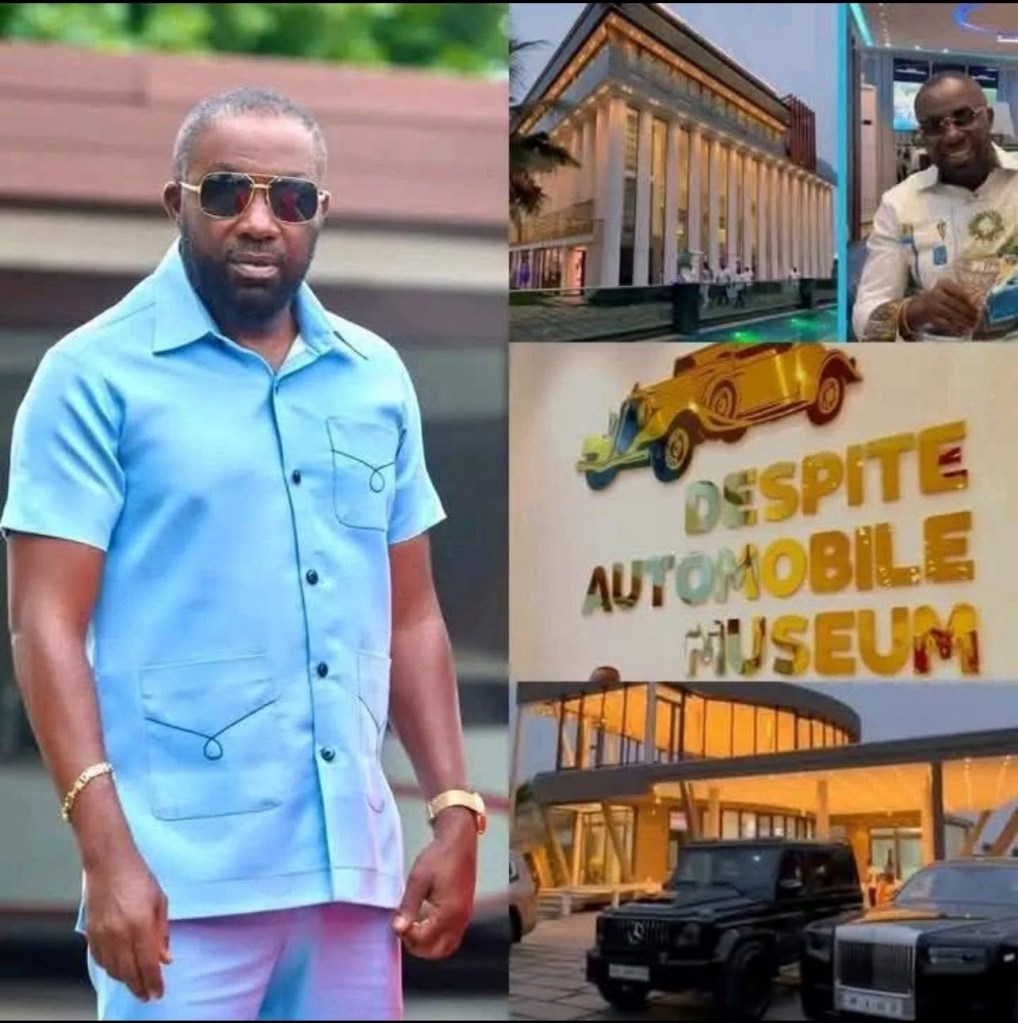
Over the weekend, something rather cinematic happened in East Legon. The Ghanaian business mogul, Mr. Osei Kwame Despite, unveiled his latest addition to Ghana’s luxury landscape — an automobile museum. No, not another car showroom or a flashy garage. A whole museum. A place dedicated to celebrating the aesthetics, engineering, and history of automobiles. In Ghana.
The ceremony? Nothing short of regal. Chaired by Otumfuo Osei Tutu II himself — yes, the Asantehene, in all his royal resplendence. Add to the guest list a political potpourri: General Mosquito (Asiedu Nketia) looking surprisingly like someone who wouldn’t mind a vintage Mustang, Ibrahim Mahama in his usual art-meets-capitalist-cool vibe, and of course, the ever-enigmatic Cheddar (Freedom Jacob Caesar) whose mere presence screams, “I, too, own a Bugatti… or two.”
And yet, while social media bathed in the gloss of Benzes and Bentleys, a deeper conversation stirred underneath the surface.
Do We Really Need This?
Some Ghanaians are side-eyeing the entire affair. “An automobile museum? In this economy?” they ask. When roads in rural districts are more pothole than pavement, when ambulance services struggle for maintenance funding, and when public schools lack desks, a monument to luxury cars feels… somewhat tone-deaf.
Critics argue this is yet another example of Ghanaian elite priorities being wildly out of sync with national development needs. What symbolic value does a museum of foreign-engineered machines offer to a country still grappling with import dependency and a weak manufacturing base? Why not a STEM centre? A vocational training hub? A transport innovation lab?
But… It’s His Money
Then there’s the “but it’s his money” camp. And to be fair, they’re not wrong. Despite is a self-made man. His rise from cassette seller to business magnate is the stuff of Ghanaian legend. If he chooses to immortalise his love for cars in a museum, who are we to police his passion?
Private citizens have always influenced public culture — think of Kwame Nkrumah and his ideological monuments, or even Ibrahim Mahama’s Red Clay Studio. In that light, the Despite Automobile Museum can be seen not merely as vanity but as cultural contribution. A Ghanaian version of Jay Leno’s garage — aspirational, curated, uniquely personal.
Some even see it as a tourism opportunity. “If we can charge dollars to see old colonial forts, why not charge to see Rolls Royces?” one supporter quipped on X (formerly Twitter). And there’s merit to that. Heritage isn’t only in artefacts from 1821; it can also be in the artefacts of aspiration, the dreams of a people on wheels.
The Bigger Picture
This event — like much of what passes as national conversation in Ghana — isn’t really about cars. It’s about the distribution of value in society. What do we celebrate? What do we preserve? Who gets to decide what is “important”? In a country where “education is the key” but “money is the padlock,” the symbolism of a luxury car museum hits a nerve.
So, yes, Despite has every right to build whatever he wants. But Ghanaians also have every right to ask what such projects say about the state of our collective imagination.
Is the Automobile Museum a symbol of ambition? A shrine to consumerism? A call for modern preservation? Or just a rich man flexing with polished chrome?
The truth is probably somewhere in between.
Final Thoughts
In a country where history is often left to rot, where libraries are underfunded and museums are ghost towns, the very idea that a museum could spark national debate is a kind of progress. Even if it’s a museum of Ferraris and Phantoms.
Let’s just hope that while we preserve the past in polished engines, we also invest in the future — in classrooms, clinics, and communities that might one day produce the engineers who build our own dream cars.
For me, I’ll just sip my sobolo and wait for the day someone opens a Public Sanitation Museum. Complete with a VR experience of using a public toilet in Nima during flood season. Now that would be realism.
In Ghana, we celebrate the cedi’s short-term gains like a political victory parade. And in 2025, the band is playing again. The cedi has appreciated by over 24% against the US dollar in just a few months, dropping from over GH₵16 to around GH₵10.35. On the surface, this looks like redemption. A national comeback. Proof that the “economic management team” is finally awake.
But before we start naming our kids after the Finance Minister, and nominate the currency for the Nobel Prize in Economic Recovery, let’s take a hard, analytical look. Because history – and economic logic – tell us this performance is more likely to be a sugar rush than a sustainable meal.
Here’s why:
Supply of Dollars Will Begin to Dry Up
When a currency appreciates sharply in a short period, it disturbs the natural rhythm of the market. Those who hold dollars become hesitant. If you had dollars at GH₵16 and now it’s GH₵13, you’re not going to rush and exchange. You’ll wait – watching nervously, hoping the cedi will slide again so you can recover your margin. This behavior is natural, and it immediately begins to choke supply.
Remittance flows, a critical lifeline of Ghana’s forex market, also respond negatively. When the cedi is weak, sending money from abroad makes sense. For instance, if someone sending $100 previously got GH₵1,600 but now gets only GH₵1,300, they may wait or send less. Some may delay their projects, especially, if the appreciation of the currency does not correspond to reduction in price of goods. That is to say, whenever there is a sharp appreciation of a currency, inflows naturally slow, and another source of foreign currency begins to dry up.
Exporters, too, feel the pinch. When they convert their dollar earnings into cedis at a weaker rate, they earn more. But with this new wave of appreciation, their revenue in local currency shrinks. Rational business people do what rational business people do: they delay repatriation, under-invoice their exports, or keep funds abroad. Again, this starves the market of much-needed forex.
Demand for Dollars Will Start Creeping Up
While the supply side begins to strain, the demand side quietly builds up pressure. A stronger cedi means cheaper imports. For a heavily import-dependent country like Ghana, this spells trouble. As imports become more affordable, importers begin to order more – everything from electronics and machinery to fuel and food. This increased demand for dollars puts pressure back on the very currency that was just gaining strength.
Then comes the speculator class. These actors don’t buy into the hype – they’ve seen this before. Every sharp appreciation, they argue, is a temporary market sugar high. So while everyone else is praising the finance ministry, speculators begin to quietly accumulate dollars, betting on the inevitable reversal. And they are often right. Once the market begins to sense that the rally is over, the panic starts. Importers scramble for dollars. Parents looking to pay school fees abroad rush to buy. Businesses accelerate their purchases. The psychology shifts from confidence to fear, and in that moment, the cedi starts its descent.
The Invisible Hand the Gravity of Reality
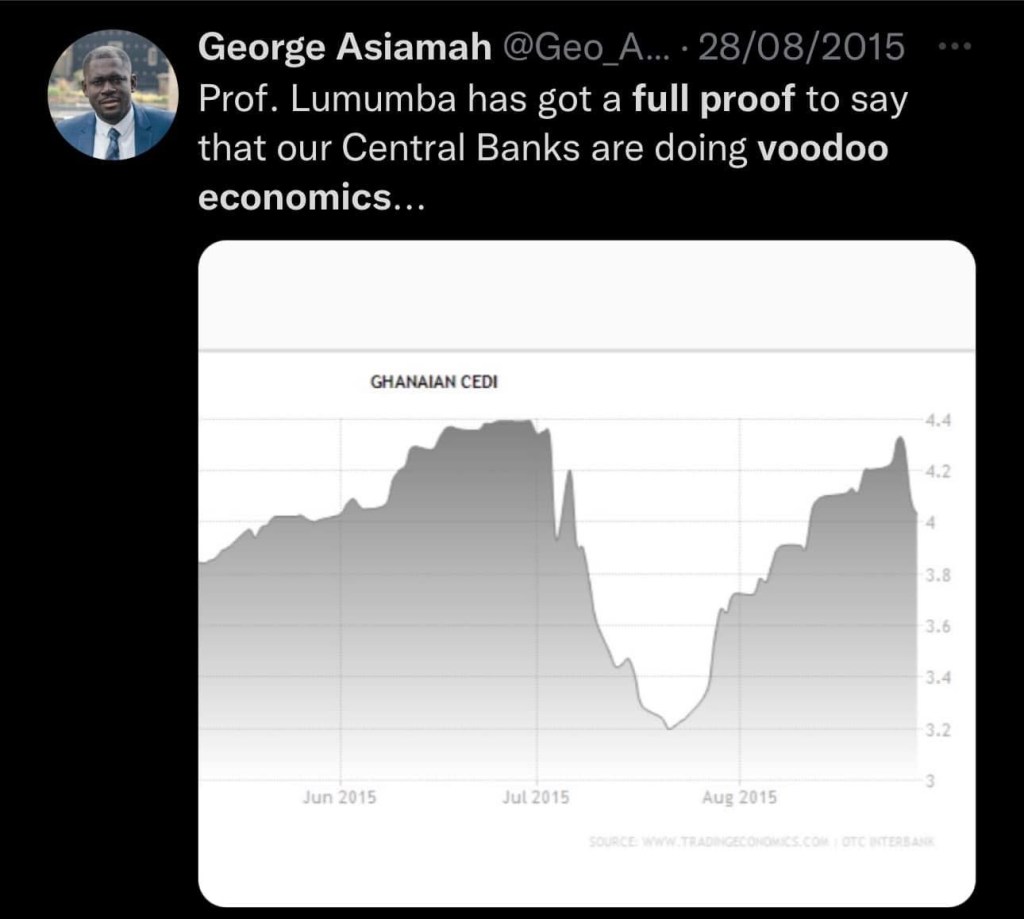
This isn’t a new story. In 2015, the cedi surged in June, and by August, it had fallen just as sharply. In 2022, the same pattern repeated. There’s nothing uniquely 2025 about this. We are simply watching the same script play out, only with new actors and slightly different lines.
What’s often missing in these debates is the understanding that the market, like nature, abhors imbalance. Adam Smith called it the “invisible hand.” But let’s call it what it is – gravity. You can push the cedi up with policy tools, foreign inflows, gold-for-oil arrangements, or central bank interventions. But if the structural foundations aren’t strong – if your economy still imports more than it exports, still depends on remittances and commodity booms, still lacks industrial depth – then the appreciation is merely a balloon on a windy day.
Eventually, gravity wins.
So yes, you may clap for the cedi now. You may tweet, “Ato Forson is the man!” or argue over whether Bawumia could’ve done this. But remember: unless we fix the fundamentals, every sharp rise will end with a fall. That’s not cynicism – it’s economics. And unlike politics, economics doesn’t campaign. It simply responds.
Over the past month, Ghanaians have witnessed a sharp appreciation of the Cedi. All the major trading currencies, especially the US Dollars, are now being humbled by our currency – causing ripples of excitement across radio shows, social media, and street corners. In a country where exchange rate movements are treated with the same passion as Black Stars matches, the recent cedi performance is naturally triggering political bragging rights.
With the NDC back in office for less than six months, some supporters have already crowned Dr. Cassiel Ato Forson the miracle worker. “What Bawumia and Ofori-Atta couldn’t do in 8 years, Ato Forson has done in 6 months!” is the new anthem of partisan pride. But while we celebrate with dancing emojis and #CediIsBack hashtags, let’s take a breath – and a glance into our rearview mirror.
Because we’ve been here before.
Déjà vu, Anyone?
In President Mahama’s first term (2012–2016), Ghanaians saw similar episodes. At one point in 2014, the cedi lost nearly 40% of its value – then made a dramatic comeback after the Bank of Ghana injected dollars and tightened monetary policy. The then Finance Minister, Seth Terkper, even launched the now infamous “Home Grown Policies” programme – celebrated by some, criticized by others, and followed by an IMF bailout.
Each time the cedi gained strength, we thought the corner had been turned. Each time, the dollar eventually reminded us who was boss.
Even under the Akufo-Addo/Bawumia administration, the cedi had its brief “honeymoon” phases – especially after Eurobond inflows, syndicated cocoa loans, or IMF disbursements. The currency appreciated, optimism surged, but then came the reversals. These were not failures of specific finance ministers alone – they were reflections of a structural vulnerability that runs deep in the Ghanaian economy.
Political Football or Economic Fundamentals?
The temptation to turn every uptick into a partisan football match is strong. We know the rules: If the cedi falls, blame the Finance Minister. If it rises, crown him saviour. But currency strength isn’t the product of charisma or political proximity to President Mills’ ghost. It’s about fundamentals, market confidence, and often, external factors we can’t control.
No doubt, the new finance minister deserves credit for calming the markets. His tone has been measured, his statements less performative than his predecessors’, and his initial actions suggest an effort to restore fiscal discipline. That said, the real test will come in:
Managing debt repayments without mortgaging future revenues;
Growing domestic production to reduce reliance on imports;
Expanding the tax base without stifling growth;
And reforming institutions to prevent future macroeconomic shocks.
Can the NDC administration resist the political pressure to over-spend ahead of elections? Can it negotiate smartly with the IMF, without triggering public backlash or social unrest? Can it shield the poor while implementing structural reforms?
That’s where the actual battle lies – not in the month-to-month dance of the exchange rate.
What Are the Real Indicators?
Is inflation down sustainably? Are we exporting more than we import? Is the tax base broadening? Are we reducing our debt-servicing burden, or merely refinancing it? These are the indicators that will tell us whether this cedi appreciation is a trend or a teaser.
We’re also yet to see the full fiscal picture. The mid-year budget will be the real test of Ato Forson’s strategy. Will he cut politically costly subsidies? Will he resist the temptation of printing money to fund populist programmes? Will he negotiate with external creditors and investors in ways that secure both debt relief and investor confidence?
These are not six-month miracles. They are long-haul battles. And even a sharp appreciation, while psychologically soothing, can come with side effects — for example, harming export competitiveness or disincentivising diaspora remittances.
A Time for Humility, Not Hype
Ghana’s economic story is complex. The cedi’s behaviour is not an emotional teenager reacting to the Finance Minister’s tone of voice; it is a reflection of deep-rooted structural issues, geopolitical dynamics, and market sentiments.
If history teaches us anything, it is that premature jubilation often precedes disappointment. So, while we appreciate the short-term gains — and God knows we needed some good news — we must resist the urge to confuse symptom relief with full recovery.
Dr. Ato Forson may well prove to be one of Ghana’s most effective Finance Ministers. But let’s give him the space and time to actually do the work, not just benefit from a temporary upswing and social media applause.
As the saying goes, “When the rain drizzles in the dry season, don’t start planting your maize just yet.”
So to my fellow Ghanaians, breathe… but don’t break into azonto just yet. The economic battle isn’t won on the forex charts of May 2025. It’s fought — and won — in the policies, institutions, and choices that shape the months and years ahead.
Ghana’s political atmosphere is sizzling as the countdown to election day narrows to mere hours. Campaign slogans, jingles, and promises are flying faster than trotro drivers on empty roads, but one stands out for its audacity: the opposition National Democratic Congress’s (NDC) promise of a 24-hour economy. Bold? Certainly. Thought out? Well, let’s just say the devil, as always, is in the details – or the lack thereof.
To be fair, the idea of a 24-hour economy isn’t inherently ridiculous. After all, cities like New York and Tokyo thrive on round-the-clock activity. The promise of bustling factories, buzzing marketplaces, and street food vendors selling kelewele under neon lights has a certain allure. Who wouldn’t want to double the economic activity, reduce unemployment, and make Ghana a beacon of efficiency on the continent?
But here’s where things get interesting. While the idea could be sold as a visionary framework – a long-term goal with well-laid plans and phased implementation – the NDC has pitched it as though it’s a policy ready to be executed after 7th January, 2025. Their pitch? Businesses willing to operate at night will receive subsidies and incentives. Sounds straightforward until you start asking questions.
And the BBC did just that. Former President John Mahama, the NDC’s flagbearer, found himself in a tight spot when asked about the cost of this grand plan. His response? A classic case of political improvisation. “You can’t put a cost on it immediately,” he said, prompting the BBC interviewer to quip, “Then it’s a gamble?” Ouch. For a man vying to regain the presidency, this wasn’t the sort of soundbite you want playing on loop 48 hours before ballots are cast.
Let’s unpack this “gamble.” Running a 24-hour economy involves more than giving night-shift businesses a few tax breaks. It requires massive investments in infrastructure: reliable electricity (hello, ECG, can we talk?), robust public transportation to move workers at odd hours, enhanced security to combat the inevitable rise in night-time crime, and even a cultural shift in how Ghanaians perceive work and leisure. And those subsidies? Somebody’s paying for them – spoiler alert: it’s us, the taxpayers.
But perhaps the most glaring omission in the NDC’s pitch is the human factor. Who is staffing this 24-hour economy? Are there enough workers ready to transition to night shifts? Will the incentives for businesses trickle down to fair wages for employees who sacrifice sleep and family time for the graveyard shift? These questions hang like Kasoa’s infamous traffic smog – visible but unanswered.
And then there’s the small matter of timing. Ghana’s economy is already stretched thin. Inflation is soaring, the cedi is on life support, and public trust in governance is shaky at best. In this context, promising a 24-hour economy without a clear roadmap is like trying to convince an athlete in critical condition to start training for the Olympics. Ambitious? Sure. Realistic? Not so much.
Ultimately, the problem isn’t the concept itself. A 24-hour economy could work – if introduced gradually, with clear goals and adequate resources. The real tragedy here is that the NDC has missed a golden opportunity. Instead of focusing on the policies that could build the foundation for such an economy – improving energy supply, boosting digital infrastructure, enhancing security, or reforming labor laws – they’ve chosen to dangle the 24-hour economy as an enticing carrot before a weary electorate. They’ve made the promise the headline, rather than the vision.
As election day nears, one can’t help but wonder if this promise will resonate with voters or serve as a stepping stone for deeper conversations about Ghana’s economic future. While the 24-hour economy feels ambitious and perhaps overly simplified in its current form, it holds potential as a bold vision that could ignite a shift in how we think about economic growth. If voters can look beyond the catchy headline and push for more robust policies to back this idea, it might just become the catalyst for meaningful transformation. Ghana has always thrived on the audacity of hope, and perhaps this promise, even in its imperfections, could spark the kind of dialogue and momentum needed to move the nation forward. After all, big dreams often pave the way for big changes.
Social media has masterfully crafted a parallel universe where everyone’s life seems to be a perpetual highlight reel. You log into Instagram, and there it is: another friend’s graduation ceremony, a cousin’s glamorous wedding, a colleague’s baby shower, a former classmate’s new car, and let’s not forget the constant stream of vacation snapshots. Over on LinkedIn, you’re bombarded with notifications of job promotions and new positions. Twitter trends are all about the latest social causes or viral moments, while TikTok is a never-ending loop of happy dances and trending challenges.
Meanwhile, here you are, still struggling to keep your head above water. You’re not sure if you’ll be able to complete that course you’ve been slogging through, and paying fees and bills feels like a never-ending nightmare. In moments of frustration, you might even find yourself muttering in Twi, “D for Dabɛn?” (When will it be my turn?) You might ask God, “When? Why only me?”
But let’s take a moment to peel back the glittery layers of this social media mirage. What you don’t see behind those perfectly curated filters and well-chosen angles are the pains, frustrations, and disappointments that everyone else is grappling with. The truth is, everybody is going through something. Some people just happen to be better actors.
Let’s start with Instagram, the land of sunsets, gourmet meals, and fit bodies. Each post is carefully crafted to show only the best aspects of life. That graduation picture? It doesn’t show the countless sleepless nights and anxiety attacks leading up to that moment. The wedding photos? They don’t capture the stress, arguments, and compromises that happen behind the scenes. The new car? A symbol of status, perhaps, but also a sign of debt and financial strain.
Now, let’s venture into the professional wonderland that is LinkedIn. It’s where everyone is constantly moving up the ladder, switching to dream jobs, and earning accolades. But what you don’t see are the long hours, the burnout, the office politics, and the fear of being replaced by someone younger and cheaper. That shiny new job title? It might come with a heap of new responsibilities and pressures that could make the person behind it yearn for simpler times.
Twitter and TikTok are the stages where everyone’s life seems like a perpetual party. The latest trends, the funniest memes, the most heartwarming stories – they all create the illusion that life is one big celebration. But what about the people behind the screens? The ones who, after logging off, might be battling loneliness, depression, or a sense of purposelessness? Those happy dances? They might be desperate attempts to find a moment of joy in otherwise bleak circumstances.
The truth is that many people use social media as their therapy session. It’s a place to project their ideal selves, to create a façade that they’re doing just fine, thank you very much. They might post a smiling selfie after a brutal breakup, a glamorous vacation shot while drowning in debt, or a celebratory post about a new job that they’re already regretting.
The irony here is palpable. You’re comparing your behind-the-scenes struggles to someone else’s highlight reel. It’s like judging a book by its Instagram cover. And in doing so, you’re picking up their therapy sessions and adding them to your own emotional baggage. It’s a recipe for a mental health disaster.
Here’s a little secret: we’re all in this together. Every single one of us is navigating the choppy waters of life, dealing with our own unique set of challenges. Some people are just better at putting on a brave face. They’ve learned to mask their pain with smiles, to hide their frustrations behind laughter, and to disguise their disappointments with filters and hashtags.
The struggle is real, and it’s universal. You are not alone. The anxiety you feel about your future, the frustration of being stuck, the fear of not measuring up – these are feelings shared by many. The difference is, some are just better at hiding it.
Social media has a way of amplifying our insecurities, making us feel like we’re falling behind while everyone else is racing ahead. But here’s a little secret: the race is an illusion. We’re all running our own marathons, on different tracks, with different obstacles. Comparing your journey to someone else’s highlight reel is not only unfair but also futile.
Instead of wallowing in self-doubt, focus on your own path. Celebrate your small victories, acknowledge your progress, and be kind to yourself. Remember that what you see online is just a fragment of someone’s life, often the best, most polished fragment. It’s like reading the blurb of a book and assuming you know the whole story. The real narrative is much more complex and multifaceted.
So, what’s the takeaway here? How do we navigate this minefield of illusions without losing our sanity?
First and foremost, remember that social media is not real life. It’s a distorted mirror that only reflects what people want you to see. The next time you feel that pang of envy or inadequacy, remind yourself that you’re only seeing a fraction of the story. Behind every perfect post is a human being dealing with their own set of struggles.
Instead of comparing yourself to others, focus on your own journey. Celebrate your small victories, no matter how insignificant they might seem in comparison to others’ grand achievements. Remember, your path is unique, and your worth is not determined by the number of likes or followers you have.
Rather than seeking validation from strangers online, invest in real relationships. Talk to friends and family about your struggles and triumphs. Find a support system that understands and accepts you, unfiltered and unedited.
Take a moment each day to reflect on the things you’re grateful for. It could be something as simple as a warm cup of tea, a kind word from a friend, or a peaceful walk in the park. Gratitude has a way of shifting our focus from what we lack to what we have.
Finally, dare to be authentic. Share your real experiences, both the good and the bad. By being vulnerable, you might just give someone else the courage to do the same. After all, real connections are built on honesty and shared experiences, not on picture-perfect illusions.
In the grand arena of social media, we’re all actors playing our parts. But behind the scenes, we’re all just humans trying to make sense of this complex, messy, and beautiful life. So, the next time you find yourself feeling like you’re miles behind in life, take a step back, breathe, and remember: you’re exactly where you need to be. Keep going, keep growing, and don’t let the illusions of social media dictate your reality.






 Dr. Asiamah's Gazette