Blog Series, Everyday Life, Ghana News, Ghana's Political Economy, Ghanaian Politics, Political Satire & Fiction, Politics, The Bandage Economy

Episode 7: Enemies Tell the Truth

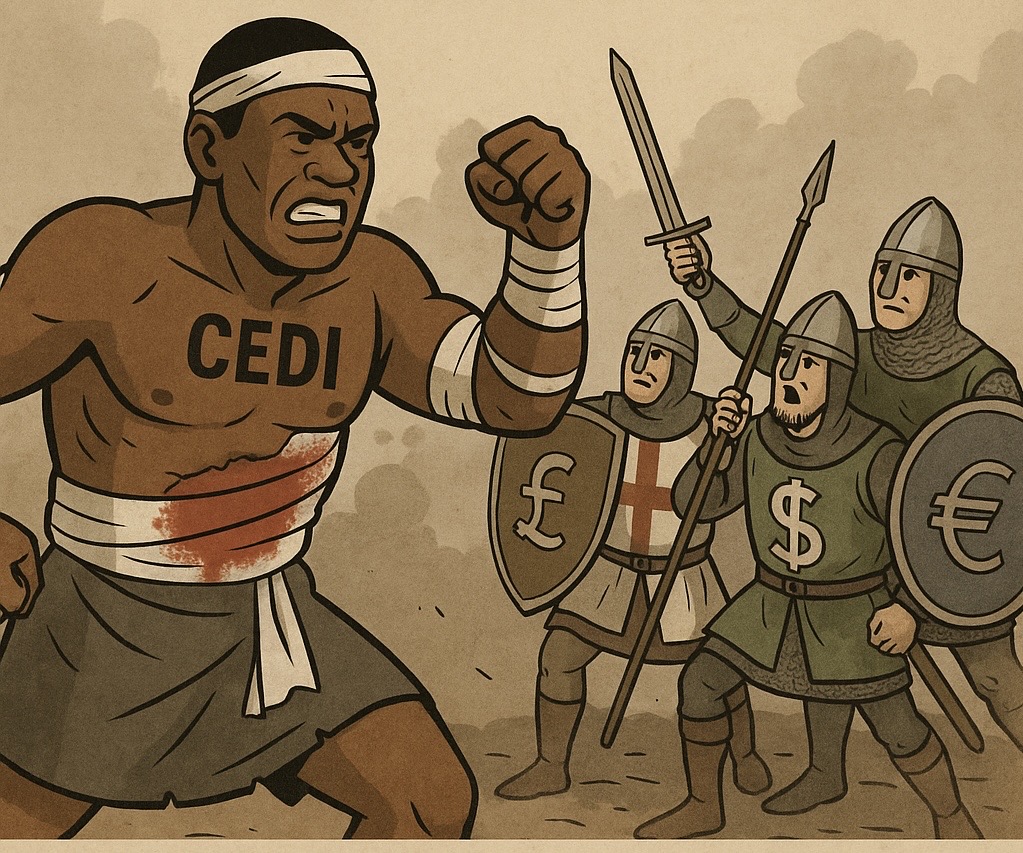
The night deepened at Agyakrom Arena. Cedi crouched in the dust, panting, his bandage damp with sweat and whispers. The steroids in his blood had dimmed; each punch now felt like an overdraft. The crowd still clapped, but their rhythm was half-hearted, like churchgoers forced to sing a hymn they don’t know the tune to.

Then something unusual happened: the giants stopped fighting.

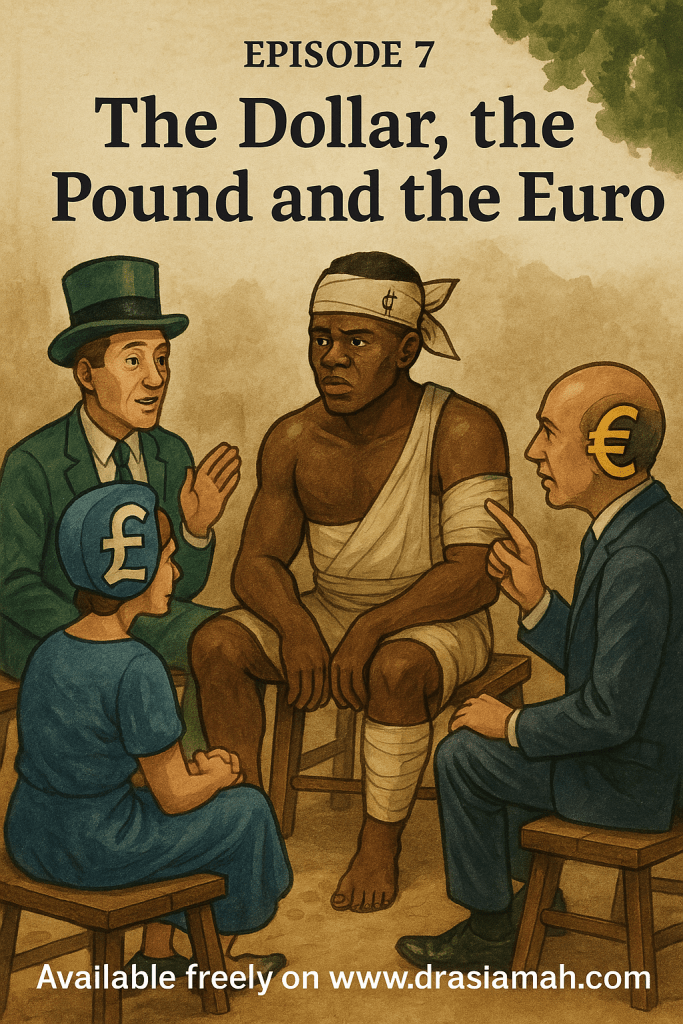
Instead of charging, DollarPound, and Euro stood tall, brushing dust from their shoulders. They looked at Cedi – not with scorn this time, but with the weary patience of creditors who have seen too many debtors at their desk. One by one, they spoke—not to taunt, but to teach.


Dollar’s Confession

Dollar stepped forward, his voice booming like oil rigs in the Niger Delta.

“Cedi, hear me. I am not just your enemy; I am your addiction. Every time you thirst for fuel, you come running to me. Every time you borrow, you do it in my name. You waste your reserves trying to tame me, but you never ask why you need me so much.

Build your own refineries, cut your deficits, grow exports, and I will lose my grip on your throat. Until then, I am your oxygen. And if you don’t manage your breath, you will choke.”

Cedi lowered his eyes. He remembered the endless fuel queues of old, the heavy import bills, the sleepless nights of central bankers.


Pound’s Sermon

Pound polished his monocle and cleared his throat like a colonial headmaster.

“Cedi, every September you flood to me with tuition fees, remittances, and consultancy payments. You drain yourself financing dreams abroad while your own schools hunger for chalk. Spare parts, luxury imports, legal advice – you lean on me for all.

Train your own teachers, fix your industries, grow your skills at home. Then I will stop being your examiner. Until then, I am your headmaster, and I mark in sterling.”

Cedi felt the sting. He saw parents selling land to send children abroad, businesses wiring pounds for spare parts, officials hiring British consultants to solve problems Ghanaian brains could have solved.


Euro’s Lecture

Euro shuffled his files, stacked neatly like regulations in Brussels.

“Cedi, your bandage will not protect you from me. You import my machines, my pharmaceuticals, my wheat, my vehicles. My standards control your exports. Until you process cocoa into chocolate, until your farmers meet sanitary tests, until your industries add value, you will remain chained to my clipboard.

Diversify, industrialise, and I will become your market instead of your master. Ignore this, and every cargo ship docking at Tema will remind you who holds the pen.”

Cedi clenched his fists, but he could not deny the truth. Even cocoa – the pride of his veins—was exported raw, only to return as imported chocolate bars.


The Old Wise Man Nods

From under the baobab, the Old Wise Man raised his staff and chuckled.

Nokware nsuo nom yɛ den.
(Truth is a hard water to swallow.)

Sometimes, even your enemies tell you the bitter truth your friends hide. Do not hate the water because it is hard; drink it and grow teeth.”

The apprentices asked, “Grandfather, why would enemies help?”

He replied: “Because they don’t need to lie. Their profit is secure. It is your pride that blinds you. A man drowning in the river may refuse the insult, but he cannot refuse the water.”


Cedi’s Reflection

For the first time, Cedi did not roar back. He sat quietly, staring at the dust. The ache under the bandage pulsed with each word.

He realised the giants were not just bullies – they were mirrors. They exposed his weaknesses: oil dependence, education outflows, import addiction. He could fight them forever and lose, or he could listen and heal.


Policy Reflection – When Enemies Tell the Truth

  • Dollar’s truth: Ghana’s dependence on oil imports and borrowing drains reserves. Real cure = refinery capacity, fiscal discipline, and export diversification.
  • Pound’s truth: Tuition, remittances, spare parts, and consultancy dependence funnel cedis into pounds. Real cure = strengthen education, industrial base, and domestic services.
  • Euro’s truth: Standards and imports tie Ghana to Europe. Real cure = add value to exports, meet standards, and industrialise.

Lesson: External powers may sound arrogant, but their pressure exposes internal weaknesses. Their insults are uncomfortable data.
Blog Series, Everyday Life, Ghana's Political Economy, Ghanaian Politics, Politics, The Bandage Economy, UK Politics

Episode 2: The Bandage Miracle

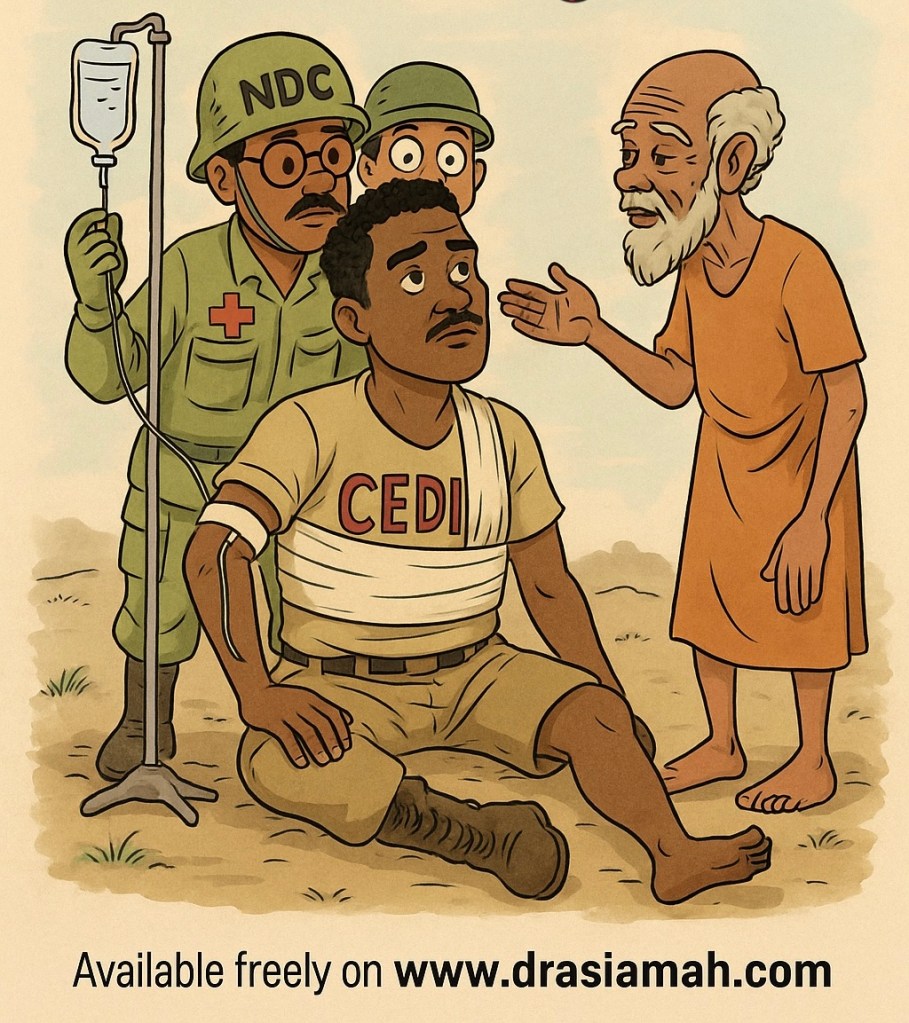
At dawn the sirens wailed and the NDC Brigade arrived – not with sabres but with stethoscopes, calculators, and a trolley that squeaked like a budget line. They found Cedi facedown, chest heaving, eyes cloudy from Dollar’s oil hooks, Pound’s spare‑parts jabs, and Euro’s paperwork chokehold.

“Vitals?” the chief medic asked.

“Pulse erratic. Confidence low. Reserves anaemic. Imports demanding transfusion,” replied the junior medic, thumbing a ledger as if it were a heartbeat monitor.

“Hmm,” the chief said, rolling up their sleeves. “We cannot build a new ribcage on the battlefield, but we can stop the bleeding and get him standing. The crowd needs a fighter, not a eulogy.”

They produced a bandage so wide it could wrap a stadium – tight enough to quiet a scream – and an ampoule labelled Booster (the kind that makes a tired goat chase a Land Cruiser). One jab. Two. A whisper of prayers and policy. The squeaky trolley exhaled.

Cedi twitched.

Another ampoule – this one called Confidence (side effects: swagger, selective hearing, short poems on social media).

Cedi blinked, sat up, spat dust, and – before anyone could recite a fiscal rule – leapt to his feet.

The arena erupted.

“Cedi! Cedi! Cedi!” The kelewele sellers beat ladles on pans; the trotro mates whistled a high‑pitch exchange rate. Even tomatoes – usually stoic – blushed a little.

Cedi tested his limbs like a man fresh from a long dream. He flexed. The bandage hugged his ribs. The Booster burned hymns in his veins. He sprinted.

First, he feinted at Dollar – a quick combination of auctions and attitude. Dollar stumbled, surprised that this same patient was now a pursuer. Then Cedi pirouetted and slapped Pound so neatly that Pound’s monocle somersaulted into the dust. Euro – never theatrical – adjusted his stack of standards but still caught a neat hook that sent three of his smaller allies scrambling for their compliance manuals.

For a moment, even the giants looked… mortal.

“Wonders shall never end!” a trader shouted, waving an invoice like a victory flag.

“See our boy – fresh like new salary!” a teacher laughed, already calculating what his arrears could buy if this miracle held.

From under the bandage, a dull ache cleared its throat. I’m still here, it said. But the drums were louder than pain, and Cedi – full of Confidence – could finally hear himself think louder than the crowd.

He prowled the ring.

Dollar scowled, nursing his jaw. “Enjoy your lap, small boy. Invoices don’t forget.”

Pound retrieved his monocle, breathing like a man who had just remembered colonialism had a returns policy. “Splendid sprint. We shall… reconcile later.”

Euro stacked his papers again – pharma, machinery, wheat – then said, softly: “Imports due is a bell that always rings.”

Cedi only grinned. The Boosters sang revival tunes. He felt strong enough to head‑butt a balance of payments.

Around the ring, Makola Market lifted one eyebrow.

Fuel sniffed. Nice footwork. Do I smell refinery discounts? No? Then I shall remain an elder.
Cement rotated its baggy shoulders. Exchange rate is cousin to my price, not my father.
Tomatoes adjusted their headscarves. We came by truck; truck speaks the language of diesel; diesel does not read hashtags.

Still, the mood was carnival. For a few glorious days, the story was simple: Cedi had fallen; Cedi had risen. The medics were geniuses. The giants had finally been taught manners. The memes were sweet; the thread counts were high.

But in the shade of the scoreboard, two apprentices of the Old Wise Man argued quietly.

“Miracle!” said the first. “Look how fast he runs.”

“Pain management,” said the second. “Look how tight the bandage is.”

They carried their debate to the baobab, where the Old Wise Man was mending a fishing net of proverbs.

“Grandfather,” they said, “is this healing?”

He smiled the patient smile of one who has buried several booms and three busts. “Listen, my children. A man with pepper in his veins can outrun a cheetah—but it is not speed; it is fire. A house painted gold will sparkle in the sun—but knock the wall, and you will meet its mud. If you hush the drum with palm oil, it will play a soft song; when harmattan comes, it will crack all the same.”

They frowned. “So…no miracle?”

“Miracles exist,” he said. “But budgets prefer arithmetic.”

Back in the ring, Cedi continued to dazzle. He threw a flurry at Dollar (call it guided auctions), feinted at Pound (call it administrative tightening), and smiled at Euro through a priority‑imports wink. Each move bought space, time, and – most valuable of all – silence from the panic that ruins weeks in a day.

The chief medic, watching from the corner, scribbled notes:

  • Stabilise the patient: reduce visible volatility; restore breath.
  • Buy time: signal discipline; calm expectations; tidy the rumour mill.
  • Manage the optics: markets eat with their eyes first.

Then, as the sun tilted, the junior medic whispered, “Chief, the vial box…”

“I know,” the chief said.

They both looked at the bandage. Under it, heat gathered like unasked questions.


Proverb of the Day:

“Sɛ wopɛsɛ wo kum aboa a, bɔ ne ti, na ɛnyɛ ne kotodwe.”
(If you intend to bring down an animal, aim for the head, not the knee.)

Meaning: Go for the root cause; don’t only stun the symptoms.


Policy Reflection – What the “Bandage” and “Booster” usually mean

The Bandage Miracle is the toolkit of short‑term forex stabilisation. It is useful – sometimes essential – on a battlefield. But it is not the surgery. Typical “bandage/booster” moves include:

  1. Heavy FX interventions (central bank sells dollars to market): calms spikes but burns reserves if not paired with real fixes.
  2. Forward auctions / tighter FX windows: guides price discovery; squeezes speculation – can also squeeze genuine importers if rationing bites.
  3. Cash‑flow steroids: one‑off inflows (IMF/BOP tranches, syndicated loans, commodity pre‑financing) that fatten reserves quickly – Powerful, but with repayment footprints.
  4. Administrative tightening: documentation checks, surrender requirements, limits on certain outflows—slows leaks; risks pushing demand to side streets.
  5. Interest‑rate signalling & liquidity mops: strengthen the carry to cool demand for foreign currency – helps the rate, but financing costs bite SMEs.
  6. Import prioritisation: channel scarce FX to essentials (fuel, medicines, inputs) – wise triage; also admits we can’t feed every appetite today.

Why it feels like a miracle: expectations flip fast. Fear goes quiet. The rate retreats. Headlines clap. But…

  • Prices don’t fall in a straight line. Inventories were bought at the old rate; fuel taxes and margins exist; transport costs are sticky; wholesalers hedge by memory.
  • Reserves are not rivers. If the surgery (exports, productivity, fiscal diet) doesn’t follow, the bandage wets through.
  • Credibility clocks tick. Markets forgive emergency medicine; they punish addiction.

So yes – stanch the bleeding. Wrap the ribs. Inject composure. But then pick up the scalpel for the real work: trimming deficits, growing exports, adding value at home, building buffers when cocoa smiles and gold winks. The crowd loves a sprint; stability is marathon grammar.

From the baobab, the Old Wise Man’s voice drifted back into the cheering:

Bandage is mercy. Booster is breath. But the head of the animal is the structure: what you make, what you sell, how you spend, how you save. Miss the head, and you will chase the tail until evening.”

Episode One: The Fall of the Cedi

Episode Three: The Giants and Their Taunts

Everyday Life, Ghana News, Ghana's Political Economy

Despite Just Built a Car Museum. Now What?

Over the weekend, something rather cinematic happened in East Legon. The Ghanaian business mogul, Mr. Osei Kwame Despite, unveiled his latest addition to Ghana’s luxury landscape — an automobile museum. No, not another car showroom or a flashy garage. A whole museum. A place dedicated to celebrating the aesthetics, engineering, and history of automobiles. In Ghana.

The ceremony? Nothing short of regal. Chaired by Otumfuo Osei Tutu II himself — yes, the Asantehene, in all his royal resplendence. Add to the guest list a political potpourri: General Mosquito (Asiedu Nketia) looking surprisingly like someone who wouldn’t mind a vintage Mustang, Ibrahim Mahama in his usual art-meets-capitalist-cool vibe, and of course, the ever-enigmatic Cheddar (Freedom Jacob Caesar) whose mere presence screams, “I, too, own a Bugatti… or two.”

And yet, while social media bathed in the gloss of Benzes and Bentleys, a deeper conversation stirred underneath the surface.

Do We Really Need This?

Some Ghanaians are side-eyeing the entire affair. “An automobile museum? In this economy?” they ask. When roads in rural districts are more pothole than pavement, when ambulance services struggle for maintenance funding, and when public schools lack desks, a monument to luxury cars feels… somewhat tone-deaf.

Critics argue this is yet another example of Ghanaian elite priorities being wildly out of sync with national development needs. What symbolic value does a museum of foreign-engineered machines offer to a country still grappling with import dependency and a weak manufacturing base? Why not a STEM centre? A vocational training hub? A transport innovation lab?

But… It’s His Money

Then there’s the “but it’s his money” camp. And to be fair, they’re not wrong. Despite is a self-made man. His rise from cassette seller to business magnate is the stuff of Ghanaian legend. If he chooses to immortalise his love for cars in a museum, who are we to police his passion?

Private citizens have always influenced public culture — think of Kwame Nkrumah and his ideological monuments, or even Ibrahim Mahama’s Red Clay Studio. In that light, the Despite Automobile Museum can be seen not merely as vanity but as cultural contribution. A Ghanaian version of Jay Leno’s garage — aspirational, curated, uniquely personal.

Some even see it as a tourism opportunity. “If we can charge dollars to see old colonial forts, why not charge to see Rolls Royces?” one supporter quipped on X (formerly Twitter). And there’s merit to that. Heritage isn’t only in artefacts from 1821; it can also be in the artefacts of aspiration, the dreams of a people on wheels.

The Bigger Picture

This event — like much of what passes as national conversation in Ghana — isn’t really about cars. It’s about the distribution of value in society. What do we celebrate? What do we preserve? Who gets to decide what is “important”? In a country where “education is the key” but “money is the padlock,” the symbolism of a luxury car museum hits a nerve.

So, yes, Despite has every right to build whatever he wants. But Ghanaians also have every right to ask what such projects say about the state of our collective imagination.

Is the Automobile Museum a symbol of ambition? A shrine to consumerism? A call for modern preservation? Or just a rich man flexing with polished chrome?

The truth is probably somewhere in between.

Final Thoughts

In a country where history is often left to rot, where libraries are underfunded and museums are ghost towns, the very idea that a museum could spark national debate is a kind of progress. Even if it’s a museum of Ferraris and Phantoms.

Let’s just hope that while we preserve the past in polished engines, we also invest in the future — in classrooms, clinics, and communities that might one day produce the engineers who build our own dream cars.

For me, I’ll just sip my sobolo and wait for the day someone opens a Public Sanitation Museum. Complete with a VR experience of using a public toilet in Nima during flood season. Now that would be realism.

Daily Motivation, Everyday Life

Social Media: Where Everyone’s Life is Perfect (Except Yours)

Social media has masterfully crafted a parallel universe where everyone’s life seems to be a perpetual highlight reel. You log into Instagram, and there it is: another friend’s graduation ceremony, a cousin’s glamorous wedding, a colleague’s baby shower, a former classmate’s new car, and let’s not forget the constant stream of vacation snapshots. Over on LinkedIn, you’re bombarded with notifications of job promotions and new positions. Twitter trends are all about the latest social causes or viral moments, while TikTok is a never-ending loop of happy dances and trending challenges.

Meanwhile, here you are, still struggling to keep your head above water. You’re not sure if you’ll be able to complete that course you’ve been slogging through, and paying fees and bills feels like a never-ending nightmare. In moments of frustration, you might even find yourself muttering in Twi, “D for Dabɛn?” (When will it be my turn?) You might ask God, “When? Why only me?”

But let’s take a moment to peel back the glittery layers of this social media mirage. What you don’t see behind those perfectly curated filters and well-chosen angles are the pains, frustrations, and disappointments that everyone else is grappling with. The truth is, everybody is going through something. Some people just happen to be better actors.

Let’s start with Instagram, the land of sunsets, gourmet meals, and fit bodies. Each post is carefully crafted to show only the best aspects of life. That graduation picture? It doesn’t show the countless sleepless nights and anxiety attacks leading up to that moment. The wedding photos? They don’t capture the stress, arguments, and compromises that happen behind the scenes. The new car? A symbol of status, perhaps, but also a sign of debt and financial strain.

Now, let’s venture into the professional wonderland that is LinkedIn. It’s where everyone is constantly moving up the ladder, switching to dream jobs, and earning accolades. But what you don’t see are the long hours, the burnout, the office politics, and the fear of being replaced by someone younger and cheaper. That shiny new job title? It might come with a heap of new responsibilities and pressures that could make the person behind it yearn for simpler times.

Twitter and TikTok are the stages where everyone’s life seems like a perpetual party. The latest trends, the funniest memes, the most heartwarming stories – they all create the illusion that life is one big celebration. But what about the people behind the screens? The ones who, after logging off, might be battling loneliness, depression, or a sense of purposelessness? Those happy dances? They might be desperate attempts to find a moment of joy in otherwise bleak circumstances.

The truth is that many people use social media as their therapy session. It’s a place to project their ideal selves, to create a façade that they’re doing just fine, thank you very much. They might post a smiling selfie after a brutal breakup, a glamorous vacation shot while drowning in debt, or a celebratory post about a new job that they’re already regretting.

The irony here is palpable. You’re comparing your behind-the-scenes struggles to someone else’s highlight reel. It’s like judging a book by its Instagram cover. And in doing so, you’re picking up their therapy sessions and adding them to your own emotional baggage. It’s a recipe for a mental health disaster.

Here’s a little secret: we’re all in this together. Every single one of us is navigating the choppy waters of life, dealing with our own unique set of challenges. Some people are just better at putting on a brave face. They’ve learned to mask their pain with smiles, to hide their frustrations behind laughter, and to disguise their disappointments with filters and hashtags.

The struggle is real, and it’s universal. You are not alone. The anxiety you feel about your future, the frustration of being stuck, the fear of not measuring up – these are feelings shared by many. The difference is, some are just better at hiding it.

Social media has a way of amplifying our insecurities, making us feel like we’re falling behind while everyone else is racing ahead. But here’s a little secret: the race is an illusion. We’re all running our own marathons, on different tracks, with different obstacles. Comparing your journey to someone else’s highlight reel is not only unfair but also futile.

Instead of wallowing in self-doubt, focus on your own path. Celebrate your small victories, acknowledge your progress, and be kind to yourself. Remember that what you see online is just a fragment of someone’s life, often the best, most polished fragment. It’s like reading the blurb of a book and assuming you know the whole story. The real narrative is much more complex and multifaceted.

So, what’s the takeaway here? How do we navigate this minefield of illusions without losing our sanity?

First and foremost, remember that social media is not real life. It’s a distorted mirror that only reflects what people want you to see. The next time you feel that pang of envy or inadequacy, remind yourself that you’re only seeing a fraction of the story. Behind every perfect post is a human being dealing with their own set of struggles.

Instead of comparing yourself to others, focus on your own journey. Celebrate your small victories, no matter how insignificant they might seem in comparison to others’ grand achievements. Remember, your path is unique, and your worth is not determined by the number of likes or followers you have.

Rather than seeking validation from strangers online, invest in real relationships. Talk to friends and family about your struggles and triumphs. Find a support system that understands and accepts you, unfiltered and unedited.

Take a moment each day to reflect on the things you’re grateful for. It could be something as simple as a warm cup of tea, a kind word from a friend, or a peaceful walk in the park. Gratitude has a way of shifting our focus from what we lack to what we have.

Finally, dare to be authentic. Share your real experiences, both the good and the bad. By being vulnerable, you might just give someone else the courage to do the same. After all, real connections are built on honesty and shared experiences, not on picture-perfect illusions.

In the grand arena of social media, we’re all actors playing our parts. But behind the scenes, we’re all just humans trying to make sense of this complex, messy, and beautiful life. So, the next time you find yourself feeling like you’re miles behind in life, take a step back, breathe, and remember: you’re exactly where you need to be. Keep going, keep growing, and don’t let the illusions of social media dictate your reality.

Daily Motivation, Everyday Life

Why Give Up Now? There’s So Much More to Complain About

Life is tough, but so are you. Yeah, I know, it sounds like something you’d find on a motivational poster hanging in a High School classroom or maybe printed on a mug in some office supply store. But here’s the thing: it’s true. Life is like that personal trainer who yells at you to keep pushing through the pain. It’s relentless, unyielding, and at times, completely infuriating. But guess what? So are you.

Think about it. You’ve made it this far, haven’t you? You’ve faced challenges, heartbreaks, failures, and a myriad of “what the actual heck” moments, and yet, here you are, still standing (or sitting, depending on your current state of affairs). You’ve weathered storms that could have knocked anyone else flat, but you kept going. Why? Because deep down, beneath all the self-doubt and the occasional Netflix binge, you know you’re capable of greatness.

Believing in yourself is a bit like learning to ride a bike. At first, it’s wobbly and terrifying. You’re not sure if you’re going to faceplant into the sidewalk or glide smoothly down the road. But with each pedal, each shaky attempt, you get a little better. Eventually, you’re zooming around, wind in your hair, feeling like you’ve conquered the world. Self-belief works in much the same way. It’s about taking that first, often shaky step and then another, and another, until you’re cruising along, confident in your abilities.

Take a moment to reflect on the trials you’ve already overcome. Remember that time you didn’t get the job you were sure was your ticket to greatness? Or when that relationship you thought would last forever crumbled like a cheap cookie? You were devastated, right? But you picked yourself up, brushed off the metaphorical dirt, and kept going. You found another job, maybe not right away, but eventually. You met new people, forged new connections, and perhaps even found someone who was a better fit. Each setback was a setup for a comeback, as trite as that might sound.

The key to all this isn’t some mystical inner strength only a few possess. It’s about persistence, plain and simple. It’s about waking up every day and deciding, sometimes against all odds, to keep moving forward. It’s not glamorous, and it sure as hell isn’t easy, but it’s what gets you through.

Believing in yourself also means acknowledging your imperfections and embracing them. You’re not a superhero, and you’re not supposed to be. Perfection is a myth perpetuated by Instagram filters and Photoshop. Real life is messy and imperfect, and that’s okay. It’s okay to admit you’re struggling. It’s okay to ask for help. And it’s definitely okay to fail. Failure is not the end of the road; it’s a detour, a chance to learn and grow.

Life is a marathon, not a sprint. There will be days when you feel like you’re running on fumes, and that’s okay. Just keep putting one foot in front of the other. Even if you’re crawling, you’re still moving forward. And if you ever doubt your strength, just look back at everything you’ve overcome. You’re still here, still fighting, still dreaming. That takes guts.

So, here’s to you, the unsung hero of your own story. Keep going. You’re stronger than you think. Believe in yourself, even if no one else does. And remember, life might be tough, but so are you. Now go out there and show the world what you’re made of. Or at least, make it through the day without losing your sanity. Either way, you’ve got this.

Daily Motivation, Everyday Life

Embrace Your Inner Strength: A Practical Guide to Self-Inspiration

In this fast-paced life where everyone is caught in the unending cycle of personal struggles, waiting for external inspiration or validation may lead to disappointment. You know, that mythical lightning bolt of creativity or motivation that supposedly transforms your life into a symphony of productivity and fulfillment. Spoiler alert: it’s not coming. So, why wait for inspiration when you can be the inspiration? Yes, you heard me right. Be your own muse. After all, nobody knows you better than you do.

First, let’s address the elephant in the room. The idea of being your own inspiration might sound like a plot twist in a self-help book that you’d rather avoid. But think about it: if you spend all your time waiting for external inspiration, you’re basically handing over the reins of your life to something as unpredictable as the weather. And we all know how reliable that is. Instead, why not embrace your inner strength and unique qualities? They are there, trust me. You just have to dust them off and put them to good use.

To start with, let’s talk about your unique qualities. Remember that time you managed to cook a decent meal without burning down the kitchen? Or when you finally figured out how to use Excel without contemplating throwing your laptop out the window? Those are the moments that show you’ve got potential. Now, imagine harnessing that potential on a daily basis. Sounds exhausting, right? But it’s actually simpler than you think. It starts with recognizing your small victories and understanding that they are the building blocks of something greater.

Now, I know what you’re thinking. “Great, another pep talk about inner strength. What’s next? Meditation and green smoothies?” Hold your horses. We’re not venturing into the realm of Instagram wellness influencers just yet. What I’m talking about is a practical approach to leveraging your inner qualities. It’s about understanding that you don’t need to scale Everest to prove your worth. Sometimes, just making it through a Monday without losing your sanity is enough to earn you a gold star.

Here’s a little secret: the journey to self-inspiration doesn’t require a grand transformation. It’s about making small, consistent changes. Start by setting achievable goals. Yes, achievable. Not those pie-in-the-sky dreams that sound impressive but are about as likely as winning the lottery. Focus on what you can do today that will make a difference tomorrow. Maybe it’s finally organizing that cluttered drawer that’s been mocking you for months. Or perhaps it’s committing to a 15-minute walk each day to clear your mind. These small steps add up, creating a ripple effect that can lead to significant changes over time.

Embracing your inner strength also means giving yourself permission to fail. Yes, fail. Because guess what? Failure is part of the process. It’s how you learn, grow, and eventually succeed. Think of it as a rite of passage. Every successful person you admire has a trail of failures behind them. They’ve just learned to see failure as a stepping stone rather than a stumbling block. So, the next time you fall flat on your face (figuratively, I hope), remember that it’s just another step on your journey to becoming your own inspiration.

Another crucial aspect is surrounding yourself with positivity. And no, this doesn’t mean you have to join a cult of relentless optimists. It’s about curating an environment that fosters growth and encourages you to be your best self. This might mean reevaluating some relationships or finding new hobbies that ignite your passion. It’s about creating a space where you can thrive rather than just survive. After all, you wouldn’t expect a plant to grow in the dark, would you?

Lastly, don’t forget to celebrate your successes, no matter how small. Reward yourself for the progress you’ve made. Treat yourself to that fancy coffee or take a day off to do absolutely nothing without feeling guilty. These moments of celebration are essential in maintaining your motivation and reminding you of why you’re putting in the effort in the first place.

So, in this fast-paced life where everyone is preoccupied with their own struggles, don’t wait for inspiration to knock on your door. It’s probably lost somewhere, trying to find the right address. Instead, be the inspiration you seek. Embrace your inner strength and unique qualities, and let them guide you on your journey. It’s not about perfection; it’s about progress. And who knows? You might just inspire others along the way.

Entertainment, Everyday Life, Ghana News

🎬🍴 Movie Review: Chef Smith – The Culinary Con🍴🎬

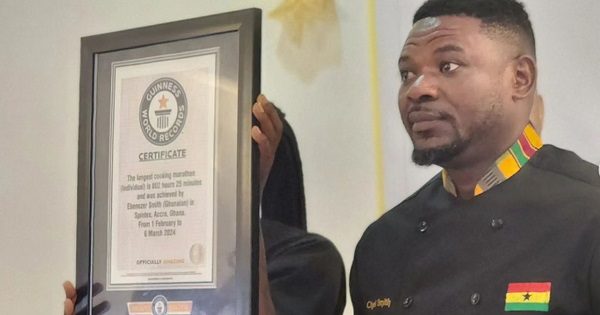
If Chef Smith’s story were a movie, I’d be lamenting the wasted popcorn. The film follows the rise and fall of Chef Smith, a man whose fake Guinness World Record award unravel faster than a batch of poorly made pastry dough.

First off, let’s talk about the plot. Chef Smith, the self-proclaimed culinary genius, is riding high on a wave of self-fabricated accolades. From a fake Guinness World Record to a bogus “International Master Chef’s Club Excellence” award, this guy’s resume is as real as a three-cedi coin. During the TV interview on GHOne, the host, playing the role of the incredulous audience surrogate, asks, “If that one too  [the International Master Chef’s Club Excellence] is fake, what’s real about you then?” And what does our protagonist respond with? “I love cooking.” Seriously? That’s your big reveal?

The film tries to sell us on the idea that Chef Smith is a mastermind of deception, but his downfall is so swift and clumsy that it’s hard to buy into it. One minute he’s the hard-nosed con artist, and the next he’s crumbling under the weight of his own lies like a ‘bumbling fool.’ It’s as if the scriptwriter couldn’t decide whether to make us hate him or feel sorry for him, and in the end, they achieved neither.

In modern societies where trust is the gold standard, Chef Smith’s antics are a stark reminder that some people will go to great lengths to fabricate success. But let’s be real: if this were a movie, I’d be shaking my head at the screenwriter’s poor handling of the climax. The transition from cunning to clueless is so abrupt it feels like we missed a few crucial scenes.

To understand where Chef Smith’s story went wrong, let’s compare it to another infamous con artist: Dr. UN. Dr. UN managed to dupe some of Ghana’s most prominent figures, including the Speaker of Parliament and top musicians, into accepting fake awards. The brilliance of Dr. UN’s character lies in his unwavering commitment to his con. Even after being exposed, he continues to defend himself with a straight face, maintaining his fictional narrative. This consistency makes him a far more compelling and believable character.

Dr. UN’s story offers a masterclass in character development. He evolves, adapting to each revelation with a new layer of audacity. Unlike Chef Smith, who falls apart as soon as the truth is revealed, Dr. UN stands his ground, adding a delicious complexity to his character. His antics are so outlandish that they border on the absurd, yet his steadfastness in the face of exposure keeps audiences hooked.

Now, the burning question: should we expect a season two of Chef Smith’s tale? Honestly, I’m torn. On one hand, the sheer absurdity of Chef Smith’s escapades has a certain train-wreck appeal – can he sink any lower? On the other hand, do we really need more of this convoluted plot? If season two promises to delve deeper into the psyche of our not-so-masterful chef and maybe throw in some redemption arc (or more ridiculous failures), it might be worth a watch. But if it’s just more of the same slapdash storytelling, I’ll pass.

Or I think if the scriptwriters decide to pursue a sequel, they’ll need to overhaul the character development significantly. Perhaps they could take a leaf out of Dr. UN’s book and build a more consistent and resilient character, one who doesn’t just fold under pressure but instead weaves a web so intricate that the audience is left in awe, even if they detest him.

In conclusion, The Culinary Con is a wild ride, but not necessarily a good one. Chef Smith’s story is one part comedy, one part tragedy, and entirely a lesson in how not to pull off a scam. Here’s hoping if there is a season two, it comes with a better script and a protagonist who’s either convincingly cunning or hilariously inept – pick a lane, Chef!

🍽️💔🍿