Agyakrom Blog Series, Blog Series, Ghana's Political Economy, Ghanaian Politics, Political Satire & Fiction, Politics, Sarcastic Commentary, The Bandage Economy

Final Episode: Habit, Not Miracle

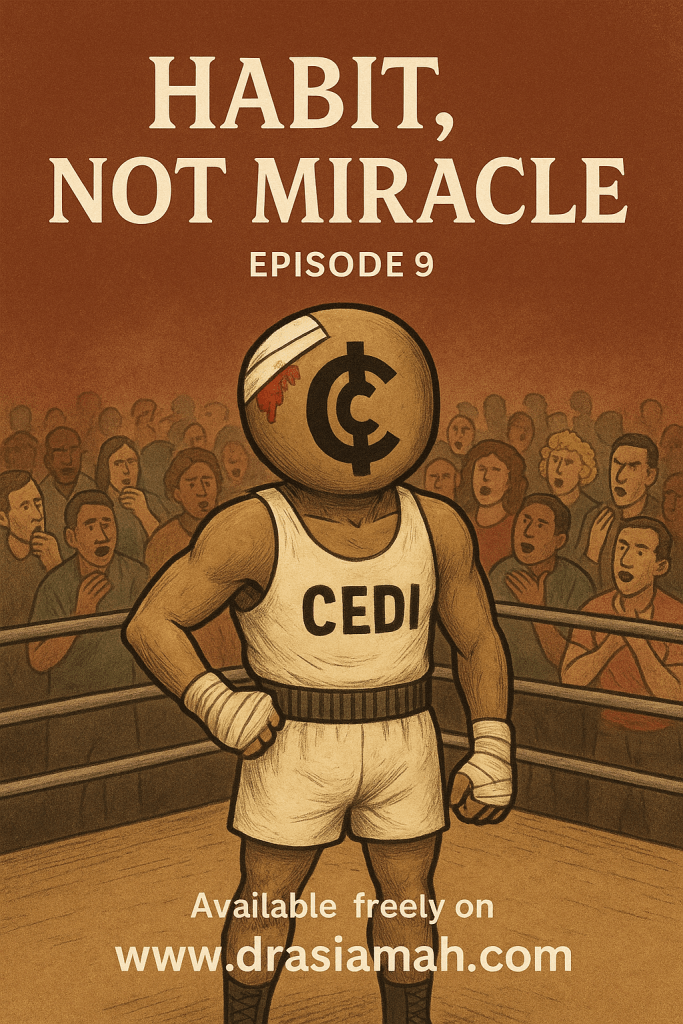
The arena was quieter now. The drums no longer beat like war; the songs of victory had faded into cautious murmurs. Cedi was not sprinting anymore. He was walking—slow, deliberate, with soap stings still fresh on his wound. His steps were heavy, but they were his own, not borrowed from a syringe.

The crowd was divided. Some sulked, disappointed that there were no fireworks or miracle punches.
“Where is the lion we saw last month?” they complained.
Others watched silently, realising for the first time that the real fight was not against the giants in the arena, but against the wounds beneath Cedi’s skin.


Cedi’s Training

Every morning, before the crowd arrived, Cedi practiced. No steroids, no bandages – just discipline.

  • He lifted sacks of local rice, learning to depend less on imported bags.
  • He sparred with cassava and yam, training his stomach to be filled by what his soil grew.
  • He studied the moves of cocoa, not as raw beans but as chocolate and cosmetics, teaching his arms to strike with value addition.
  • He jogged alongside industry, sweating to build factories that could meet Euro’s clipboard standards.

It was not glamorous work. There were no cheering trotro mates, no dancing politicians. But slowly, his muscles remembered how to fight without artificial strength.


The Giants Observe

Dollar folded his arms. “Hmm. He is learning to refine oil? This may weaken my hold.”

Pound frowned. “He is training teachers and engineers at home? That might reduce my September harvest.”

Euro adjusted his clipboard. “If his factories begin to meet my standards, he may turn from applicant to competitor.”

The giants did not panic; they were too seasoned for that. But for the first time, they respected Cedi – not for his sprint, but for his discipline.


The Crowd Learns

At first, the people complained. Prices did not fall overnight. Kenkey was still arguing with transport. Waakye was still gossiping with taxes. But as moons turned into seasons, they noticed something strange:

  • Tomatoes stopped panicking every time Dollar coughed.
  • Cement began to price itself with more confidence.
  • Farmers smiled as local rice found loyal customers.
  • The fuel pump still frowned, but less often than before.

The people realised: true strength is not a miracle – it is a habit.


The Old Wise Man’s Final Lesson

Under the baobab, the Old Wise Man raised his staff one last time.

“Ahwenepa nkasa.”
(Precious beads do not rattle.)

He explained:
“Real strength is quiet. It does not announce itself with noise or slogans. It is seen in steady prices, in factories that hum daily, in reserves that sleep peacefully, in farmers who plan next season without fear. Cedi must not chase applause anymore; he must build silence that lasts.”

The apprentices bowed. “So, Grandfather, the battle is not won in one miracle?”

He smiled. “No, my children. Miracles impress crowds. Habits build nations.”


Policy Reflection – The Long Lesson of Cedi

  1. Short-term fireworks don’t feed households. True stability comes from structural reforms: diversifying exports, building local industries, investing in agriculture, and fiscal discipline.
  2. Habit beats miracle. A currency that steadily strengthens on productivity and buffers is worth more than one that sprints on steroids.
  3. Quiet progress is real progress. The best economic victories are invisible—when prices stay steady, when reserves quietly grow, when the exchange rate ceases to dominate the evening news.
  4. Resilience over applause. The goal is not to “beat Dollar, Pound, or Euro” in a sprint but to build an economy that does not collapse when they flex.

Closing Scene

As the sun set over Agyakrom Arena, Cedi stood tall – not roaring, not sprinting, but breathing steadily. The crowd no longer screamed his name, but they watched him with a new kind of respect.

For the first time in years, Cedi was not a miracle patient or a wounded warrior. He was simply a fighter in training – learning that the true battle is not won in the arena but in the habits of the everyday.

And under the baobab, the Old Wise Man whispered to himself:

“Strength is not a miracle. Strength is a habit.”
Agyakrom Blog Series, Ghana News, Ghana's Political Economy, Ghanaian Politics, Political Satire & Fiction, Politics

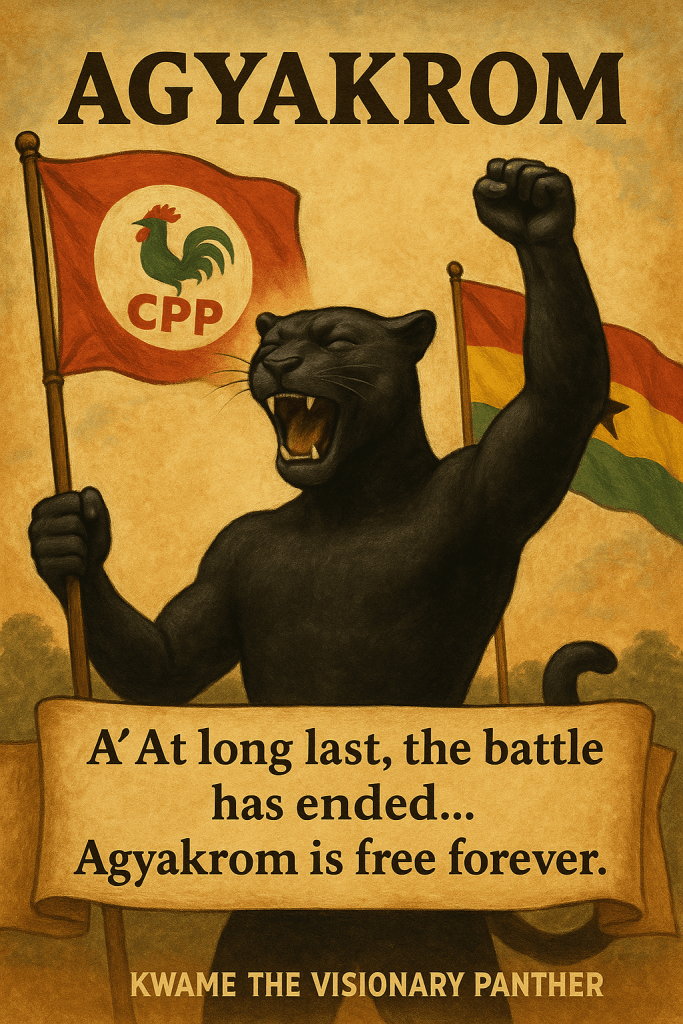
Episode 2: At Long Last… Agyakrom is Free!

“When the drums of freedom beat, even the slowest beast begins to dance.”

By the early 20th century, young beasts in Agyakrom demanded answers. Beasts who read the colonial scrolls and saw the hypocrisy. Beasts who had drunk both palm wine and European philosophy. Beasts who demanded a Free Jungle.

One of them stood tall.

He was fast.
He was fierce.
He was relentless.

His name? Kwame the Visionary Panther.

Not born into wealth.
Not descended from chieftain trees.
But his speed was unmatched – both in thought and in speech.

He returned from the icy forests of foreign lands with a tail full of socialist theories, a mane full of Pan-African dreams, and a scroll titled “Positive Action.”


The UGCC and the Great Split

Before the Panther returned to Agyakrom, there existed a cautious committee of beasts known as the United Grove for Common Creatures (UGCC). Composed of owls, elder elephants, scholarly squirrels, and coconut-sipping lawyers, this elite circle wanted the colonial zookeeper gone – but politely. Through letters. Through procedures. Through distant petitions and gentlemanly growls.

They needed a spark. A beast with a voice that could rally the groundlings, not just the treehouse elites.

So they summoned the Panther – fresh from foreign groves, fire in his bones, socialism on his breath. Educated in the books of faraway lands, but burning with the fury of local injustice, the Panther spoke not like a bureaucrat, but like a prophet.

At first, he served them dutifully – the UGCC’s roarer-in-chief. But soon, friction brewed. The Panther moved too fast. Dreamed too loud. Called for immediate freedom, while the elders still debated resolutions.

He was bold. They were cautious.

He roared: “Self-rule now! Not next year, not when approved by colonial tail-waggers. Now!”

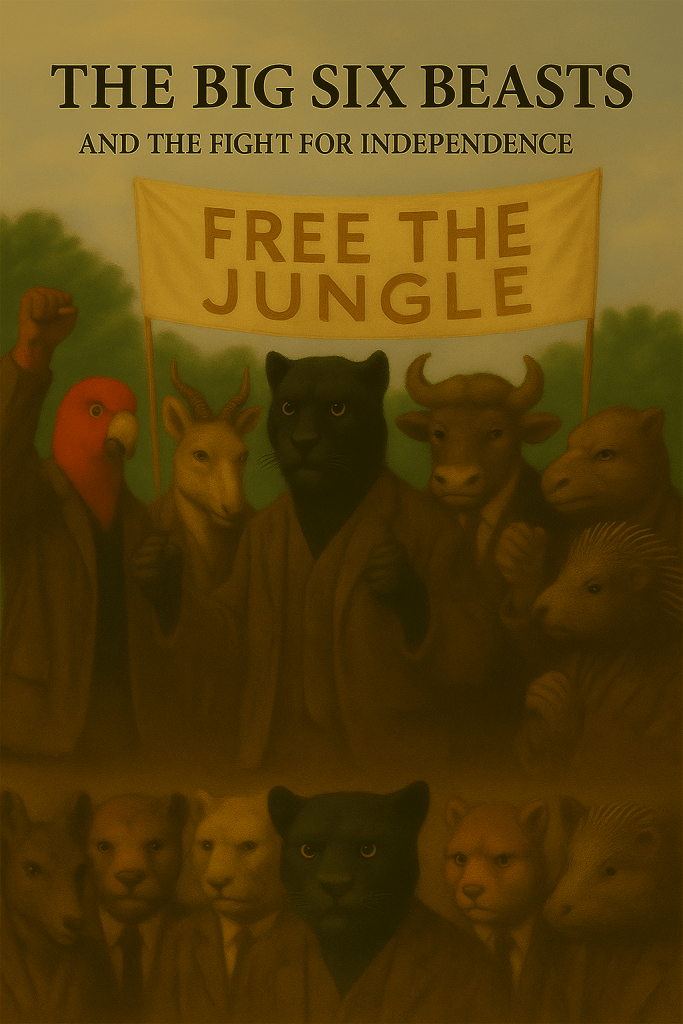
And so he broke off. He formed his own rebel camp. He built the Crop Protection Party (CPP) – a movement not of parchment and protocol, but of farmers, fisher-beasts, and furious youth.

He mobilised monkeys in the markets, drummers in the bush, cocoa porters, cassava vendors, and even the goats who had never been counted in jungle censuses.

Positive Action and the Beast Awakening

Under the Panther’s call, the jungle stirred. Farmers refused to send cocoa to colonial depots.
Teachers marched out of classrooms. Market mamas sang protest songs at dawn. Young cubs – who once only fetched water and memorised empire poems – began distributing leaflets and climbing platform trees to speak.

The colonial gatherers and zookeepers panicked. They arrested the Panther.

But that only made him a martyr.

While he sat in silence, his name echoed through the vines. His image spread across banana leaflets. His supporters, fierce and loyal, would not rest.

“Free the Panther!”
“The jungle must be ours!”
“Down with the Bulldog Empire!”


The Election That Changed the Jungle

In 1951, the hunters and the gatherers – realising the jungle’s heat could no longer be managed with cold treaties – organised an election.

The Panther ran from his prison cell.

And he won.

Landslide.

The message was clear: the jungle no longer wanted caretakers in suits.

It wanted leaders who ran with the people.


The Independent Jungle

Right from the start, the Panther did not rest. He dreamt big. Lived large. Built fast.

Banana factories. Coconut oil refineries. Cashew trains stretching across canopy corridors. He constructed cocoa processing hubs. He summoned engineers to build the mighty Volta Dam, a monument to modernity that promised power for all. The Black Star shipping fleet roamed the seas.

He didn’t stop at infrastructure. He wrote books. He launched five-year plans. He gave speeches that turned parrots into philosophers and squirrels into citizens.

African beasts across the continent looked to Agyakrom and said: “If they can run free, so can we.”

The Panther became not just a leader, but a symbol.

His dreams were continental. He envisioned a Union of Forest States. He funded liberation struggles in neighbouring groves. He hosted pan-jungle conferences where beasts debated unity in twenty dialects.

To the West, he was dangerous. To the oppressed, he was divine.

He welcomed revolutionaries.
He built a new capital.
He preached unity.

He declared:

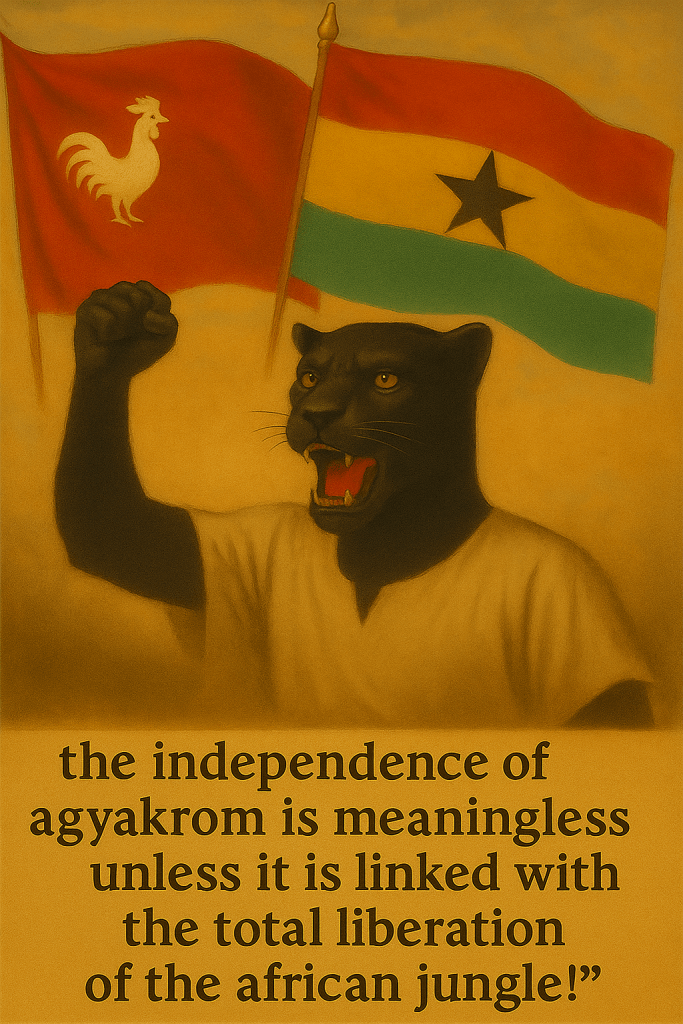
“The independence of Agyakrom is meaningless unless it is linked with the total liberation of the African jungle!

But… 

JUNGLE WISDOM OF THE DAY

“When the chains fall off the paws, the mind must still unlearn the leash.”