Every jungle has a history. But not every beast remembers.
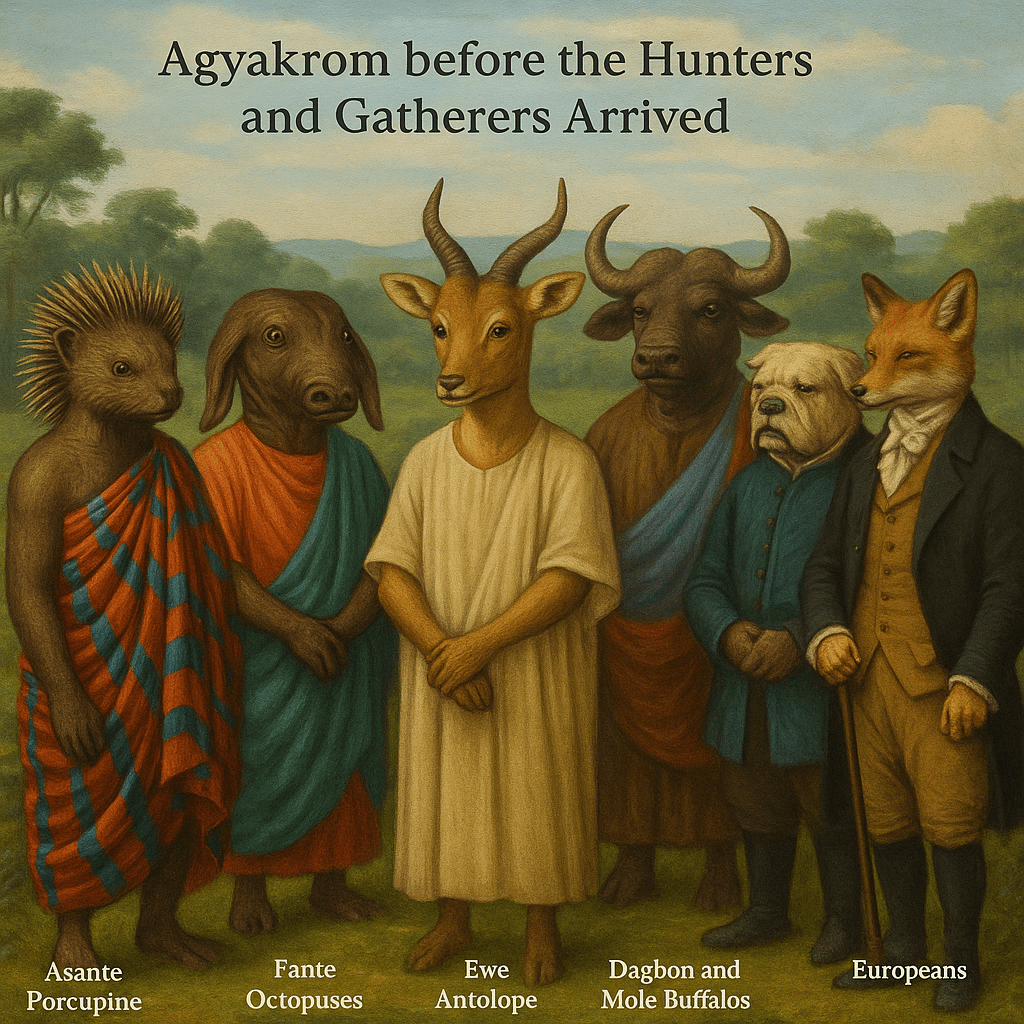
Long before thrones, ballots, slogans, and scandals, there was a vast land in the western belly of the African continent – a place of gold, rivers, thick forests, and proud beasts.
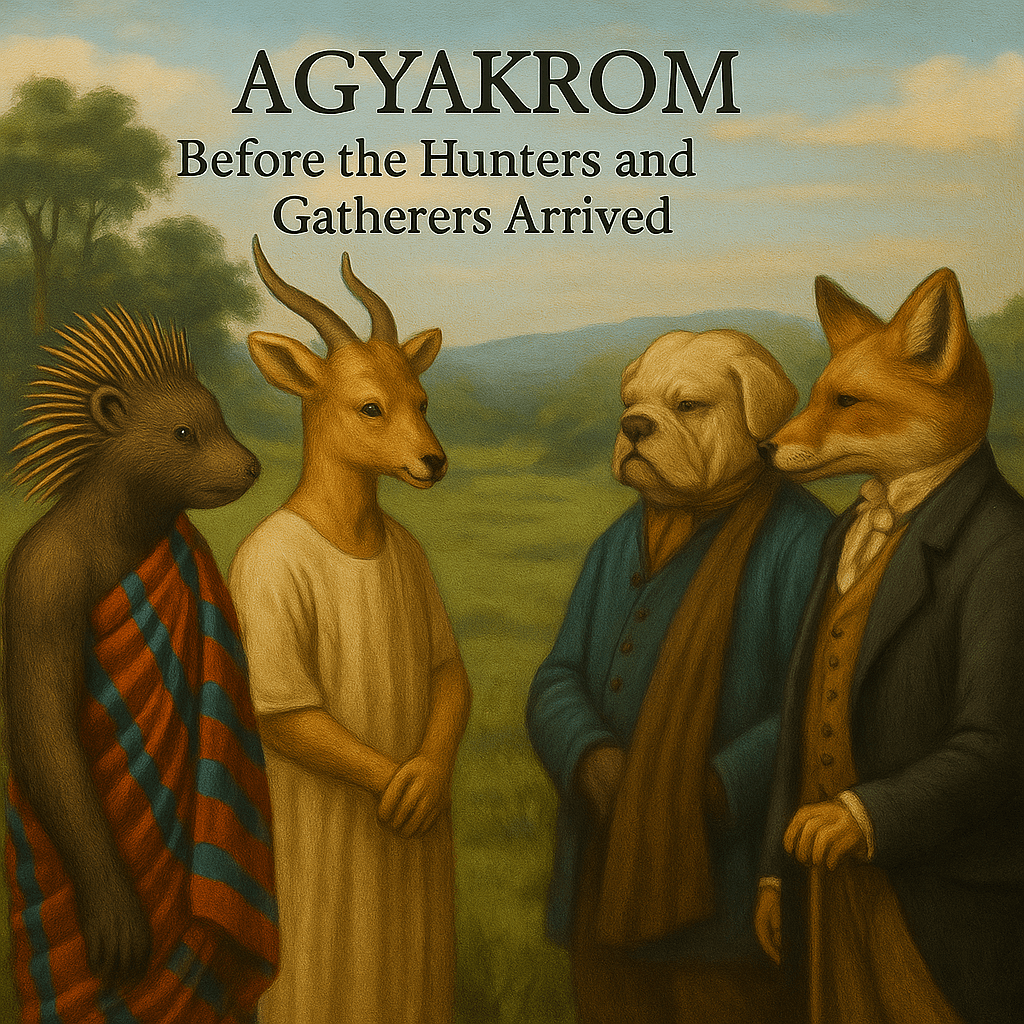
They called it Agyakrom.
It was not yet a republic.
It was not yet even a country.
It was a patchwork of powerful animal clans – Asante Porcupines, Ewe Antelopes, Mole-Dagbani Buffalos, Fante Octopuses, Ga jackals, and many more – each with their own kings, traditions, markets, shrines, and seasonal drumbeats.
They lived not in utopia, but in order.
The rivers flowed with rhythm.
The forests echoed with proverbs.
The elders ruled with stools, not scrolls.
And then – the hunters came.
The Coming of the Hunters and Gatherers
No one knows exactly when the first Hunter ship hit the shores. But the river whispers tell of the time when strange, light-skinned creatures – two-legged, clothed in iron and greed – arrived with crosses, coins, and chains.
They came bearing gifts: mirrors, rum, muskets, and the Holy Scroll.
But beneath their cloaks were ledgers.
The jungle called them The Gatherers.
Because that’s what they did.
They gathered:
• Gold from the Lion caves,
• Ivory from the forest bones,
• Palm oil from the Monkey Groves,
• And worst of all, beasts themselves – from the weakest cubs to the strongest buffaloes.
They said they had come to civilise.
But civilisation came with shackles.
For over three hundred rainy seasons, Agyakrom watched its children carried across oceans.
And when the chains were finally lifted, the Gatherers returned – not with whips, but with Rule.
The Jungle Becomes a Colony
They called it a protectorate.
Then a colony.
Then a gold coast – not because of the coast, but because of the gold.
They drew borders like scratch marks on a termite map.
They made laws in languages no beast spoke.
They crowned chiefs they could control.
They introduced currency, courts, and new religion – leaving confusion and conversion in equal measure.
The Jungle Parliament? Replaced by District Commissions.
The beast customs? Replaced by colonial codes.
The jungle’s soul? Traded for infrastructure and flags.
Agyakrom, the free land of many tribes, became a colony.
And the beasts began to forget they were once sovereign.
But as every wise monkey knows:
You can cage a lion, but you cannot silence the growl forever.
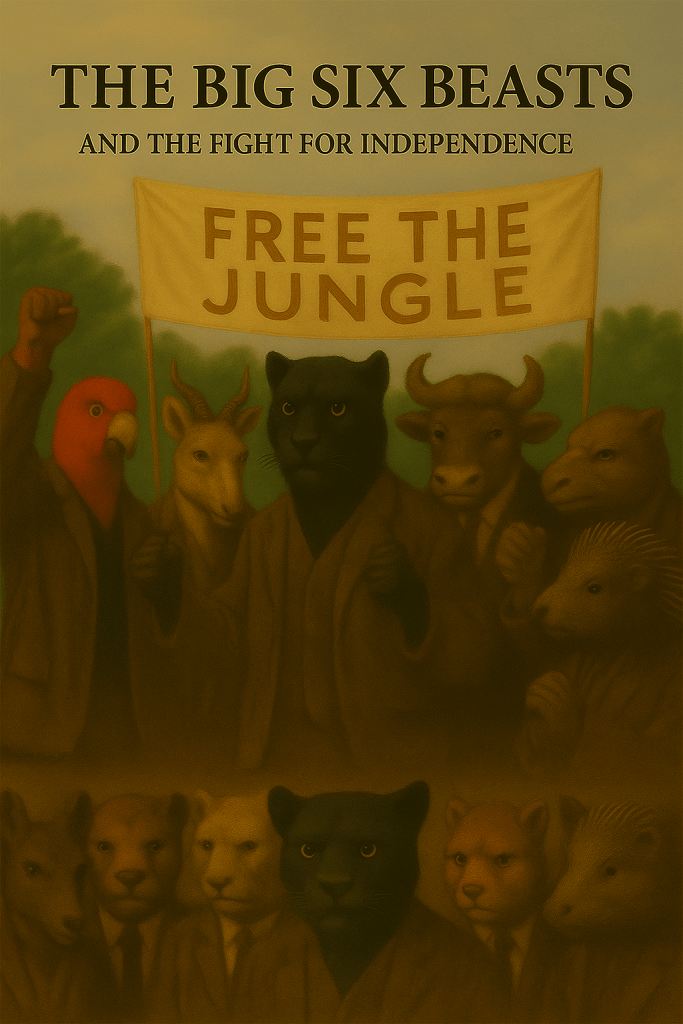
The Rise of the Roaring Beasts
By the early 20th century, the jungle began to stir.
Young beasts – some educated abroad, some trained in the colonial classrooms, others shaped by the fireside wisdom of their elders – began to ask dangerous questions.
“Why must we fetch water for their baths while our rivers run dry?”
“Why must our cocoa feed their children, but not ours?”
The great independence struggle was born.
JUNGLE WISDOM OF THE DAY
A Beast that forgets where it came from will never know where it is going
Watch Out for Episode 2: The Struggle for Independence
On 4 June 2025, Ghana’s Parliament passed a controversial bill introducing a one-cedi per litre levy on petroleum products – framed as a necessary intervention to address the ever-growing debt in the energy sector and, ultimately, to end the country’s lingering electricity supply challenges, popularly known as “dumsor.” The ruling NDC government justified the move by pointing fingers at the mismanagement of the previous administration, suggesting that the Energy Sector Recovery Programme had failed to achieve its intended financial restructuring. Now, they argue, it falls upon the public to pay – not for their sins, but for those of their predecessors. The catch? They promise this is the last push, the final Cedi to buy stability. One more sacrifice so we may see the light, literally.
But this move raises deeper questions about Ghana’s fiscal and political architecture, the nature of state-society relations, and the recurring tension between revenue mobilisation and public trust. While on the surface, the D-Levy is merely an energy financing mechanism, at its core, it exemplifies the political economy of managing scarcity, debt, and blame in a fragile democracy. Ghana has been here before. Levies have often emerged as government tools of last resort – temporary solutions that quietly become permanent fiscal burdens. Recall the price stabilisation levy, the sanitation levy, and more recently, the infamous e-levy. Many were billed as short-term interventions. Few were repealed. Even fewer were transparently accounted for.
To understand the deeper dilemma, one must examine the contradiction embedded in this levy. On the one hand, government presents it as an unavoidable necessity – the only path to restructuring the crippling legacy debt owed to Independent Power Producers (IPPs), fuel suppliers, and financiers. On the other, it insists that the cost to consumers will be negligible because the Cedi has recently appreciated, causing a marginal drop in pump prices. This is a risky fiscal narrative. It assumes currency appreciation is stable, and that petroleum product prices are not volatile. But in Ghana, neither is guaranteed. In fact, both are shaped by exogenous global shocks, domestic political risks, and structural vulnerabilities. To peg the justification for a permanent levy to a temporary macroeconomic blip is, at best, politically disingenuous.
Moreover, this levy arrives at a time when the government is trying to demonstrate that it is reversing some of the more unpopular decisions of the previous regime. The removal of the e-levy, a tax on electronic transactions, was lauded as a win for ordinary Ghanaians. But with the new D-Levy, critics argue, the government has merely shifted the burden from the digital economy to the pump. As some have quipped, “E-levy out, Dumsor D-Levy in.” The logic of this substitution is hardly comforting. For many households and informal sector workers, the increase in transport fares triggered by the levy could be more punitive than the e-levy they celebrated seeing repealed. The narrative, then, becomes one of robbing Peter to pay Paul, all under the guise of energy stability.
The political economy implications are profound. First, the D-Levy reinforces a trend in Ghanaian fiscal policy where governments resort to indirect taxes and levies to fund structural inefficiencies, rather than addressing the root causes. These include overcapacity in power generation, misaligned procurement contracts, and opaque financial arrangements with IPPs. Second, it exposes the failure of successive governments to ringfence public funds or build institutional trust. Civil society actors have long complained about the lack of transparency in how energy levies are spent. Audits are sporadic, reports often withheld, and public oversight weak. In this environment, even a well-meaning levy appears predatory.
Finally, this situation raises philosophical questions about who bears the cost of public failure in Ghana. Is it fair to ask today’s citizens to fund yesterday’s poor contracts, bloated power deals, and policy inertia? And if so, where is the evidence that this new stream of revenue will be managed differently? The D-Levy is not just about energy – it is about the moral and institutional legitimacy of governance. It is about the citizen’s role not just as taxpayer, but as shareholder in a public enterprise that seems to suffer from chronic mismanagement. If the goal is to end dumsor, then fiscal tools must be matched with structural reforms, transparency, and a governance model that rewards efficiency rather than excuses it.
In the end, Ghana’s energy future cannot be levied into stability. It must be planned, trusted, and built. A one-cedi solution to a multi-billion dollar governance problem may win a few political points in the short term. But without systemic reform, it risks becoming just another levy in the dark.
In Ghana, we celebrate the cedi’s short-term gains like a political victory parade. And in 2025, the band is playing again. The cedi has appreciated by over 24% against the US dollar in just a few months, dropping from over GH₵16 to around GH₵10.35. On the surface, this looks like redemption. A national comeback. Proof that the “economic management team” is finally awake.
But before we start naming our kids after the Finance Minister, and nominate the currency for the Nobel Prize in Economic Recovery, let’s take a hard, analytical look. Because history – and economic logic – tell us this performance is more likely to be a sugar rush than a sustainable meal.
Here’s why:
Supply of Dollars Will Begin to Dry Up
When a currency appreciates sharply in a short period, it disturbs the natural rhythm of the market. Those who hold dollars become hesitant. If you had dollars at GH₵16 and now it’s GH₵13, you’re not going to rush and exchange. You’ll wait – watching nervously, hoping the cedi will slide again so you can recover your margin. This behavior is natural, and it immediately begins to choke supply.
Remittance flows, a critical lifeline of Ghana’s forex market, also respond negatively. When the cedi is weak, sending money from abroad makes sense. For instance, if someone sending $100 previously got GH₵1,600 but now gets only GH₵1,300, they may wait or send less. Some may delay their projects, especially, if the appreciation of the currency does not correspond to reduction in price of goods. That is to say, whenever there is a sharp appreciation of a currency, inflows naturally slow, and another source of foreign currency begins to dry up.
Exporters, too, feel the pinch. When they convert their dollar earnings into cedis at a weaker rate, they earn more. But with this new wave of appreciation, their revenue in local currency shrinks. Rational business people do what rational business people do: they delay repatriation, under-invoice their exports, or keep funds abroad. Again, this starves the market of much-needed forex.
Demand for Dollars Will Start Creeping Up
While the supply side begins to strain, the demand side quietly builds up pressure. A stronger cedi means cheaper imports. For a heavily import-dependent country like Ghana, this spells trouble. As imports become more affordable, importers begin to order more – everything from electronics and machinery to fuel and food. This increased demand for dollars puts pressure back on the very currency that was just gaining strength.
Then comes the speculator class. These actors don’t buy into the hype – they’ve seen this before. Every sharp appreciation, they argue, is a temporary market sugar high. So while everyone else is praising the finance ministry, speculators begin to quietly accumulate dollars, betting on the inevitable reversal. And they are often right. Once the market begins to sense that the rally is over, the panic starts. Importers scramble for dollars. Parents looking to pay school fees abroad rush to buy. Businesses accelerate their purchases. The psychology shifts from confidence to fear, and in that moment, the cedi starts its descent.
The Invisible Hand the Gravity of Reality
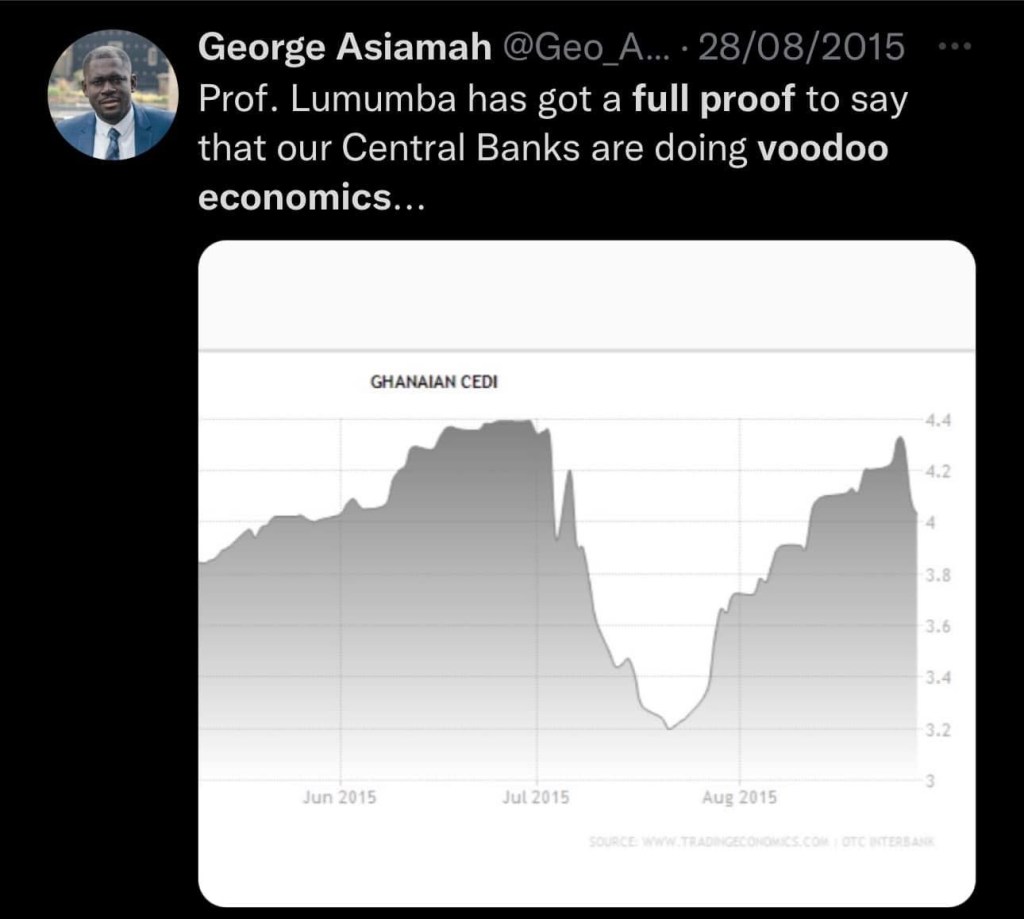
This isn’t a new story. In 2015, the cedi surged in June, and by August, it had fallen just as sharply. In 2022, the same pattern repeated. There’s nothing uniquely 2025 about this. We are simply watching the same script play out, only with new actors and slightly different lines.
What’s often missing in these debates is the understanding that the market, like nature, abhors imbalance. Adam Smith called it the “invisible hand.” But let’s call it what it is – gravity. You can push the cedi up with policy tools, foreign inflows, gold-for-oil arrangements, or central bank interventions. But if the structural foundations aren’t strong – if your economy still imports more than it exports, still depends on remittances and commodity booms, still lacks industrial depth – then the appreciation is merely a balloon on a windy day.
Eventually, gravity wins.
So yes, you may clap for the cedi now. You may tweet, “Ato Forson is the man!” or argue over whether Bawumia could’ve done this. But remember: unless we fix the fundamentals, every sharp rise will end with a fall. That’s not cynicism – it’s economics. And unlike politics, economics doesn’t campaign. It simply responds.
Over the past month, Ghanaians have witnessed a sharp appreciation of the Cedi. All the major trading currencies, especially the US Dollars, are now being humbled by our currency – causing ripples of excitement across radio shows, social media, and street corners. In a country where exchange rate movements are treated with the same passion as Black Stars matches, the recent cedi performance is naturally triggering political bragging rights.
With the NDC back in office for less than six months, some supporters have already crowned Dr. Cassiel Ato Forson the miracle worker. “What Bawumia and Ofori-Atta couldn’t do in 8 years, Ato Forson has done in 6 months!” is the new anthem of partisan pride. But while we celebrate with dancing emojis and #CediIsBack hashtags, let’s take a breath – and a glance into our rearview mirror.
Because we’ve been here before.
Déjà vu, Anyone?
In President Mahama’s first term (2012–2016), Ghanaians saw similar episodes. At one point in 2014, the cedi lost nearly 40% of its value – then made a dramatic comeback after the Bank of Ghana injected dollars and tightened monetary policy. The then Finance Minister, Seth Terkper, even launched the now infamous “Home Grown Policies” programme – celebrated by some, criticized by others, and followed by an IMF bailout.
Each time the cedi gained strength, we thought the corner had been turned. Each time, the dollar eventually reminded us who was boss.
Even under the Akufo-Addo/Bawumia administration, the cedi had its brief “honeymoon” phases – especially after Eurobond inflows, syndicated cocoa loans, or IMF disbursements. The currency appreciated, optimism surged, but then came the reversals. These were not failures of specific finance ministers alone – they were reflections of a structural vulnerability that runs deep in the Ghanaian economy.
Political Football or Economic Fundamentals?
The temptation to turn every uptick into a partisan football match is strong. We know the rules: If the cedi falls, blame the Finance Minister. If it rises, crown him saviour. But currency strength isn’t the product of charisma or political proximity to President Mills’ ghost. It’s about fundamentals, market confidence, and often, external factors we can’t control.
No doubt, the new finance minister deserves credit for calming the markets. His tone has been measured, his statements less performative than his predecessors’, and his initial actions suggest an effort to restore fiscal discipline. That said, the real test will come in:
Managing debt repayments without mortgaging future revenues;
Growing domestic production to reduce reliance on imports;
Expanding the tax base without stifling growth;
And reforming institutions to prevent future macroeconomic shocks.
Can the NDC administration resist the political pressure to over-spend ahead of elections? Can it negotiate smartly with the IMF, without triggering public backlash or social unrest? Can it shield the poor while implementing structural reforms?
That’s where the actual battle lies – not in the month-to-month dance of the exchange rate.
What Are the Real Indicators?
Is inflation down sustainably? Are we exporting more than we import? Is the tax base broadening? Are we reducing our debt-servicing burden, or merely refinancing it? These are the indicators that will tell us whether this cedi appreciation is a trend or a teaser.
We’re also yet to see the full fiscal picture. The mid-year budget will be the real test of Ato Forson’s strategy. Will he cut politically costly subsidies? Will he resist the temptation of printing money to fund populist programmes? Will he negotiate with external creditors and investors in ways that secure both debt relief and investor confidence?
These are not six-month miracles. They are long-haul battles. And even a sharp appreciation, while psychologically soothing, can come with side effects — for example, harming export competitiveness or disincentivising diaspora remittances.
A Time for Humility, Not Hype
Ghana’s economic story is complex. The cedi’s behaviour is not an emotional teenager reacting to the Finance Minister’s tone of voice; it is a reflection of deep-rooted structural issues, geopolitical dynamics, and market sentiments.
If history teaches us anything, it is that premature jubilation often precedes disappointment. So, while we appreciate the short-term gains — and God knows we needed some good news — we must resist the urge to confuse symptom relief with full recovery.
Dr. Ato Forson may well prove to be one of Ghana’s most effective Finance Ministers. But let’s give him the space and time to actually do the work, not just benefit from a temporary upswing and social media applause.
As the saying goes, “When the rain drizzles in the dry season, don’t start planting your maize just yet.”
So to my fellow Ghanaians, breathe… but don’t break into azonto just yet. The economic battle isn’t won on the forex charts of May 2025. It’s fought — and won — in the policies, institutions, and choices that shape the months and years ahead.
As the UK barrels towards the 2024 general election, the agricultural sector, often the quiet backbone of the nation, finds itself in a peculiar position. Historically overlooked in the glitz and glamour of campaign promises, agriculture now sits awkwardly in the limelight. It’s a sector that doesn’t scream for attention like health or immigration, but without it, we’d all be pretty hungry. So, what do our noble politicians have in store for the farmers who toil the land and, by extension, for the rest of us who benefit from their hard work?
Let’s be honest: agriculture isn’t the sexiest topic on the campaign trail. It’s not going to win over city dwellers preoccupied with the latest tax policies or NHS reform. Yet, agriculture is the thread that ties us all together, whether we realise it or not. Every tax policy, trade agreement, and environmental regulation reverberates through the fields and pastures, affecting what ends up on our dinner tables.
First, let’s talk about the Conservatives. The party that traditionally prides itself on supporting business and industry, but often finds itself in a bit of a pickle when it comes to agriculture. Rishi Sunak’s government has promised to support British farmers, but the specifics are as murky as a ploughed field after a rainstorm. They talk a good game about maintaining high standards for food production and animal welfare, but there’s a catch. They’re also all in for free trade agreements that sometimes prioritise cheaper imports over home-grown produce. The classic Conservative dilemma: to protect or to profit?
Sunak’s stance on agriculture seems to be a balancing act between pandering to rural voters and keeping urbanites happy with low food prices. On one hand, they’re promising subsidies and support for innovative farming practices. On the other, their trade deals with countries like Australia and the US could undercut British farmers. It’s like promising a kid candy, then handing it to his richer, more powerful cousin. Farmers might get some help to innovate, but they’ll also face tougher competition from imports that don’t always meet the same rigorous standards.
Switching gears to Labour, Keir Starmer is trying to paint a brighter future for British agriculture, but not without his own set of contradictions. Labour’s manifesto is big on sustainability and green farming practices, aiming to make British agriculture the poster child for environmental responsibility. Starmer wants to invest heavily in organic farming, reduce pesticide use, and increase biodiversity. It sounds wonderful, doesn’t it? Until you realize that this vision comes with a hefty price tag.
Labour’s green dreams are noble, but they could also mean higher costs for farmers and, consequently, higher prices for consumers. It’s the classic green vs. greenbacks conundrum. How much are we willing to pay for sustainability? And more importantly, how much are farmers willing to change without going bankrupt? Labour promises grants and financial support, but the practicalities of such a transition could make the difference between thriving farms and deserted fields.
Moreover, both parties have to grapple with the implications of Brexit. Yes, the B-word. Brexit has already turned the agricultural sector upside down, shaking up trade routes and supply chains. The Common Agricultural Policy (CAP) of the EU, which provided substantial subsidies to UK farmers, is a thing of the past. The government’s replacement, the Environmental Land Management Scheme (ELMS), is supposed to reward farmers for environmentally friendly practices. It’s a nice idea on paper, but the rollout has been slower than a tractor in first gear.
Under the ELMS, farmers are encouraged to enhance biodiversity, improve water quality, and reduce carbon emissions. However, the transition from the old subsidy system to this new, greener approach has left many farmers uncertain and anxious. The Conservatives assure us that this will ultimately benefit both the environment and the farmers, but the immediate reality feels like asking a marathon runner to switch to high heels halfway through the race.
Adding to the complexity, immigration policy throws another spanner in the works. The agricultural sector heavily relies on seasonal migrant workers, and immigration rules have tightened post-Brexit. Both Labour and the Conservatives acknowledge this issue, but their solutions differ. Labour proposes more flexible immigration rules to ensure farms have the labour they need. The Conservatives, however, focus on automation and mechanization as a long-term solution, a vision that sounds futuristic but may leave farmers struggling in the short term.
In practical terms, let’s take a hypothetical farmer, Mr. Green, who runs a modest dairy farm in Somerset. Under the Conservatives, Mr. Green might receive some support to adopt new technologies, but he’ll also face competition from imported dairy products. He could invest in robotic milkers, but these come with high upfront costs and a steep learning curve. Meanwhile, if Labour takes the helm, Mr. Green might get subsidies to turn his farm organic. However, transitioning to organic farming isn’t just a matter of flipping a switch; it requires time, money, and a market willing to pay premium prices for organic milk.
The crux of the matter is that agriculture is more interconnected with other policies than many care to acknowledge. Economic strategies, trade deals, immigration laws, and environmental policies all converge on the farms across the UK. Yet, the discourse remains fragmented, with agriculture often treated as a peripheral issue rather than a central pillar of policymaking.
Consider the linkage between trade policies and agriculture. A free trade agreement with Australia, which the Conservatives boast about, might reduce tariffs on Australian beef. This could be great for consumers craving cheaper steaks, but what about British beef farmers? They’re suddenly competing with vast Australian ranches where production costs are lower. The impact isn’t just economic; it’s cultural and environmental. British farmers often maintain hedgerows and woodlands, contributing to the rural landscape and biodiversity, practices not necessarily mirrored by their Australian counterparts.
On the immigration front, the seasonal nature of farm labour demands a flexible, reliable workforce. The Conservatives’ push towards automation might seem like a futuristic solution, but machines can’t pick strawberries with the same care and efficiency as human hands. Labour’s approach to ease immigration restrictions for seasonal workers might keep the farms running, but it’s a temporary fix to a deeper issue of workforce stability and rural employment.
Agriculture is also a bellwether for economic health. When farms struggle, rural economies suffer. The decline of small farms leads to the decay of rural communities, loss of local markets, and a disappearance of traditional knowledge and skills. A thriving agricultural sector, supported by coherent policies, not only feeds the nation but also sustains rural life and traditions.
So, as the election looms, what should farmers do? The answer is as complex as the issues they face. Voting isn’t just a matter of picking the party with the shiniest manifesto. It’s about considering the broader implications of each policy and how it intertwines with the practicalities of running a farm. Farmers must weigh the promises against the realities of their daily lives, considering both short-term needs and long-term sustainability.
In the end, the 2024 election might not revolutionise British agriculture, but it will set the tone for the next few years. Whether it’s through better trade deals, sensible immigration policies, or realistic environmental goals, the future of farming hinges on political decisions made today. As politicians jostle for votes, let’s hope they remember the hands that feed the nation. Because without them, all their grand promises will be worth less than a hill of beans.
In the realm of Ghanaian politics, few figures have seen their reputations transform as dramatically as Dr. Mahamudu Bawumia. Once hailed as the economic messiah, Bawumia rode a wave of optimism and high expectations when he assumed the role of Vice President in 2017. His economic credentials and promises of transformative policies positioned him as a beacon of hope for many Ghanaians. However, fast forward to the present, and the economic landscape has shifted dramatically. With the country grappling with significant economic challenges, the once-revered Bawumia is now the subject of widespread criticism. But is it fair to place the blame for Ghana’s economic crisis squarely on his shoulders?
To understand the current economic situation and Bawumia’s role in it, we must first revisit the context of his rise to prominence. Dr. Bawumia entered the political arena with a robust academic background and considerable experience in economic policy. His tenure at the Bank of Ghana and his work with international financial institutions gave him a reputation for expertise that was unmatched by many of his peers. When he was selected as the running mate for Nana Akufo-Addo in the 2016 elections, it was clear that the New Patriotic Party (NPP) was banking on his economic prowess to turn around the fortunes of the nation.
Upon assuming office, Bawumia’s initial efforts appeared promising. He championed various reforms aimed at stabilising the economy, reducing inflation, and fostering growth. His policies on financial inclusion and digitalisation, such as the mobile money interoperability system, were hailed as innovative steps towards modernising Ghana’s economy. For a while, it seemed that Bawumia was delivering on his promises. However, the economic realities of governance soon began to test his capabilities.
The global economic environment has always had a significant impact on Ghana’s economy. Factors such as fluctuations in commodity prices, especially for cocoa and gold, have historically influenced economic stability. The COVID-19 pandemic, which erupted in 2020, dealt a severe blow to economies worldwide, and Ghana was no exception. The pandemic disrupted supply chains, reduced economic activity, and necessitated increased government spending to mitigate its effects. These external shocks contributed to a strained economic environment, complicating Bawumia’s efforts to maintain stability.
Internally, Ghana’s economy faced structural issues that predated Bawumia’s tenure but which he had to contend with. The country’s debt levels have been a persistent concern, with successive governments borrowing to finance development projects. While infrastructure development is crucial, the accompanying debt burden has often led to economic constraints. Bawumia inherited an economy already grappling with these challenges, and his policies, though well-intentioned, had to navigate this complex landscape.
One of the central criticisms leveled against Bawumia is the perceived disconnect between his promises and the outcomes. Critics argue that despite his assurances, the economic indicators have not improved as expected. Inflation has remained a thorny issue, with prices of essential goods and services continuing to rise, impacting the everyday lives of Ghanaians. The depreciation of the cedi, Ghana’s currency, against major international currencies has further exacerbated the situation, increasing the cost of imports and contributing to inflationary pressures.
However, attributing these economic woes solely to Bawumia overlooks the multifaceted nature of economic governance. The Vice President, while influential, operates within a broader government framework where various actors and factors play critical roles. Fiscal policy, largely driven by the Ministry of Finance, and monetary policy, managed by the Bank of Ghana, both significantly impact economic outcomes. Bawumia’s influence, though notable, is part of a collective effort that includes other key players in the government.
Moreover, economic policy implementation is not an instant process. The effects of policy changes often take time to manifest fully. Some of Bawumia’s initiatives, particularly in the digitalisation space, are long-term projects whose benefits may not be immediately visible. The push for a cashless society and the integration of digital technologies into various aspects of the economy are ambitious undertakings that require sustained effort and time to yield significant results.
The political dimension of Bawumia’s predicament cannot be ignored. In the high-stakes arena of Ghanaian politics, economic performance is a critical determinant of public perception and electoral success. As the Vice President and a prominent figure in the ruling NPP, Bawumia is a natural target for political opponents seeking to undermine the government’s credibility. The narrative of failure, therefore, serves not only as an economic critique but also as a strategic tool in the political contest for power.
Furthermore, the expectations placed on Bawumia were extraordinarily high. His branding as an economic savior created a perception that he had almost magical abilities to fix the economy. Such expectations were always unrealistic and set the stage for disappointment. The complexities of economic management, especially in a developing country with numerous structural challenges, mean that no single individual, regardless of expertise, can singlehandedly transform the economy.
In analysing Bawumia’s role and responsibility for the economic crisis, it is essential to adopt a balanced perspective. While he is undoubtedly a significant player and his policies and decisions have impacted the economy, the broader context in which these policies were implemented must be considered. External economic shocks, pre-existing structural issues, and the collaborative nature of governance all contribute to the current situation.
Moving forward, it is crucial for Ghana to adopt a holistic approach to economic management. This involves not only addressing immediate challenges but also implementing long-term strategies to build resilience and foster sustainable growth. Strengthening institutions, enhancing transparency and accountability, and promoting diversification of the economy are critical steps in this process. The lessons from the current crisis should inform future policies, ensuring that the economy is better prepared to withstand shocks and uncertainties.
Dr. Bawumia’s journey from economic messiah to embattled Vice President is a reflection of the broader complexities of governance and economic management. While his tenure has seen both achievements and setbacks, it is clear that the challenges facing Ghana’s economy cannot be attributed to him alone. A nuanced understanding of the factors at play and a collective effort to address them are essential for the country’s progress.
Overall, while Dr. Mahamudu Bawumia’s role in the current economic crisis is significant, it is not singularly determinative. The economic challenges Ghana faces are the result of a confluence of internal and external factors, structural issues, and policy decisions that extend beyond any one individual. Blaming Bawumia alone oversimplifies the complexities of economic governance and overlooks the collaborative nature of government operations. It is essential to move beyond the scapegoating and focus on comprehensive strategies to build a more resilient and prosperous economy for all Ghanaians.
In Ghanaian political landscape, new figures occasionally emerge, promising to shake up the status quo and offer fresh perspectives. One such figure is Nana Kwame Bediako, popularly known as Cheddar, a man who has swiftly risen to prominence, particularly among the youth. But as his star ascends, questions arise: Is Cheddar a genuine leader with a vision for Ghana’s future, or is he merely a populist, capitalising on discontent and making grand promises that lack substance?
Nana Kwame Bediako is a charismatic entrepreneur and philanthropist. His appeal lies largely in his success story, which resonates deeply with many Ghanaians. His business ventures, particularly in real estate and technology, showcase his entrepreneurial acumen and have garnered him considerable wealth and influence. Cheddar’s foray into politics has been marked by a savvy use of social media and public appearances to cultivate an image of a man of the people. He speaks directly to the frustrations and aspirations of Ghana’s youth, a demographic that constitutes a significant portion of the population. With unemployment rates high and economic opportunities limited, young Ghanaians are desperate for change, and Cheddar’s message of empowerment and innovation strikes a chord.
One of the key aspects of Cheddar’s appeal is his promise to address the economic challenges facing the country. He speaks passionately about the need for economic transformation, emphasising entrepreneurship, technological advancement, and education as pillars of his vision. His rhetoric suggests a deep understanding of the structural issues that hinder economic growth and a commitment to implementing policies that can drive sustainable development.
However, it is essential to scrutinise whether Cheddar’s promises are backed by concrete plans and realistic strategies. Populist leaders often gain traction by offering simple solutions to complex problems, and it remains to be seen whether Cheddar can translate his ideas into actionable policies. His emphasis on entrepreneurship, for example, is laudable, but fostering a thriving entrepreneurial ecosystem requires more than just encouraging people to start businesses. It involves creating an enabling environment with access to capital, mentorship, and markets, as well as addressing systemic issues such as corruption and bureaucratic inefficiencies.
Cheddar’s rise also raises questions about his understanding of governance and his ability to navigate the intricacies of political leadership. Successful entrepreneurship does not necessarily equate to effective governance. The skills required to run a business differ significantly from those needed to manage a country. Governance involves balancing competing interests, making tough decisions, and working within a framework of checks and balances. While Cheddar’s business success is impressive, it does not automatically qualify him to lead a nation.
Moreover, Cheddar’s political rhetoric, while inspiring, sometimes lacks specificity. His speeches and social media posts are filled with motivational language and grand visions, but details on how he plans to achieve these goals are often sparse. This raises concerns about whether his platform is based on substantial policy proposals or if it is merely designed to capture the imagination of disillusioned voters. Take, for example, his brilliant plan to dredge the sea all the way to Kumasi, a landlocked city. I mean, come on, that is pure genius, innit? It is no wonder everyone is rolling on the floor laughing at the sheer brilliance of it all – sarcasm intended. But, on the more serious note, genuine leadership requires not only vision but also a clear and practical roadmap for achieving that vision.
Another critical aspect of Cheddar’s rise is his relationship with existing political structures and elites. Populist leaders often position themselves as outsiders challenging the establishment, but they must also navigate the realities of political alliances and power dynamics. Cheddar’s ability to build coalitions, work with other political actors, and gain the trust of established institutions will be crucial in determining whether he can effect real change or if he will be sidelined by the very system he seeks to reform.
Furthermore, Cheddar’s personal wealth and business interests could potentially pose conflicts of interest. Transparency and accountability are vital in political leadership, and there must be mechanisms to ensure that his business dealings do not unduly influence his political decisions. Already, there have been numerous questions and allegations about his source of wealth. I mean, come on, starting a poultry farm with just a single chicken? That is some real “rags to riches” story right there! And selling scraps to make a million? Sounds like he’s been watching too many episodes of “Trash to Treasure” on TV.
The response of the Ghanaian public to Cheddar’s rise is also telling. While he enjoys significant support among the youth, his appeal among older generations and more conservative segments of society is less certain. Building a broad-based coalition that transcends age, ethnicity, and socioeconomic status will be essential for any leader aspiring to govern effectively. Cheddar’s ability to unite different factions and present a coherent, inclusive vision for Ghana’s future will be a key test of his leadership.
Critics of Cheddar argue that his rise is indicative of a broader trend of celebrity culture infiltrating politics, where charisma and media presence overshadow substantive policy discussions. They caution against the allure of charismatic figures who promise quick fixes but may lack the depth and experience required for effective governance. The history of populist leaders across the globe provides numerous examples of initial enthusiasm giving way to disappointment when rhetoric fails to translate into reality.
In contrast, supporters believe that Cheddar represents a new breed of leader, one who understands the aspirations of the younger generation and is not tainted by the failures of the past. They argue that his business acumen and fresh perspective are precisely what Ghana needs to break free from the cycle of mediocrity and corruption that has plagued its politics. For these supporters, Cheddar is not just a populist; he is a visionary leader capable of driving genuine transformation.
As Cheddar continues to build his political profile, it will be essential to watch how he addresses these critiques and navigates the complexities of leadership. His ability to articulate a clear and detailed policy agenda, demonstrate a commitment to transparency and ethical governance, and build broad-based support will determine whether he is a genuine leader or simply a populist figure.
Overall, Cheddar’s rise in Ghanaian politics is a phenomenon that encapsulates the hopes and frustrations of a significant segment of the population. His message of empowerment and economic transformation resonates deeply with the youth, who are eager for change. However, the true test of his leadership will lie in his ability to move beyond populist rhetoric and deliver tangible results. As Ghana looks to the future, the question remains: Will Cheddar emerge as a genuine leader capable of driving sustainable change, or will he be another in a long line of populist figures whose promises fall short? Only time will tell, but the stakes for Ghana’s future have never been higher.
As the 2024 general elections approach, the political stage of Ghana is set for yet another captivating performance. Among the protagonists is Dr. Mahamudu Bawumia, the current Vice President, who is seeking to transition from his role as the “mate” to the main driver of the nation’s bus. His campaign slogan, “mo mfa steer no ɛma me,” which translates to “give me the steering wheel,” suggests a shift from being a mere assistant to taking full control. But can Ghanaians trust him with the wheel, considering the potholes and detours that have marred the journey so far?
Dr. Bawumia’s tenure as Vice President has been a tale of two cities: the optimistic early days when he was celebrated as the economic messiah and the more recent times marked by economic turbulence. He entered the political arena with a promise to fix the economy, stabilise the cedi, reduce inflation, and create jobs. His detailed lectures and data-driven presentations in the run-up to the 2016 elections painted a picture of a man who had all the answers. He criticised the then-incumbent NDC government for economic mismanagement and assured Ghanaians that the NPP had the magic formula to turn things around.
However, as any seasoned traveller knows, the road to development is fraught with unforeseen obstacles. The economy, despite Bawumia’s earlier assurances, has faced significant challenges. High inflation, a depreciating currency, and rising public debt have left many Ghanaians questioning the promises made. The global COVID-19 pandemic and the Russia-Ukraine war have undoubtedly contributed to these difficulties, but they have also revealed the fragility of the country’s economic foundations. The bus ride has been bumpy, and passengers are understandably anxious about handing over the steering wheel to the man who was supposed to navigate these treacherous roads.
In Ghanaian culture, the role of the “mate” in a trotro (public minibus) is crucial. The mate collects fares, helps passengers with their luggage, and communicates with the driver about stops and routes. While indispensable, the mate is not the one who steers the vehicle. Dr. Bawumia’s assertion that he was just the mate, and that the real driver was President Nana Akufo-Addo, is a clever metaphor. It absolves him, to some extent, from the full responsibility of the economic woes and shifts the focus on what he could do if given full control.
But Ghanaians are not easily swayed by metaphors and clever slogans. They are practical people who judge leaders by their actions and results. The question on everyone’s mind is whether Dr. Bawumia, if given the steering wheel, can indeed drive the country towards prosperity. His emphasis on digitalisation is commendable. Initiatives such as the digital property address system, mobile money interoperability, and efforts to digitise public services are steps in the right direction. They represent a modern vision for Ghana’s future, one where technology plays a central role in governance and economic development.
However, digitalisation alone cannot solve the immediate economic issues that Ghanaians face. Inflation, unemployment, and the high cost of living are pressing concerns that require immediate and tangible solutions. The average Ghanaian cares more about the price of kenkey and fish than about blockchain technology. Dr. Bawumia needs to demonstrate that his vision for digitalisation can translate into real benefits for the ordinary citizen. This means creating jobs, stabilising prices, and ensuring that the economic gains from digital initiatives trickle down to all levels of society.
Principally, the notion of leadership is deeply connected with the concept of trust. In many ways, a leader is like a bus driver entrusted with the safety and well-being of their passengers. The driver must have a clear sense of direction, be able to anticipate and avoid obstacles, and maintain the confidence of those on board. Dr. Bawumia’s request for the steering wheel is a request for trust, a call for Ghanaians to believe in his ability to lead them to a better future.
Then again, trust is a fragile commodity in politics. Dr. Bawumia’s previous role as the mate has given him an intimate understanding of the country’s challenges and the expectations of its people. But transitioning to the role of the driver means more than just holding the steering wheel; it means earning the trust of the passengers. This trust is built on a track record of delivering on promises and demonstrating competence in times of crisis. Ghanaians need to believe that Dr. Bawumia has not only the vision but also the capability to navigate the country through turbulent times.
Dr. Bawumia’s campaign strategy must therefore be multifaceted. He needs to address the immediate economic concerns of Ghanaians while also presenting a long-term vision for digital transformation. This requires a delicate balance between practicality and innovation. On one hand, he must offer concrete solutions to stabilise prices, create jobs, and manage public debt. On the other hand, he needs to articulate how digitalization can drive economic growth, improve public services, and enhance the quality of life for all Ghanaians.
Moreover, Dr. Bawumia must engage directly with the electorate. He needs to listen to their concerns, understand their frustrations, and provide reassurances that he is capable of leading the country through these challenging times. This means going beyond the data and statistics that characterised his previous lectures and connecting with people on a personal level. Ghanaians want to see a leader who is not only knowledgeable but also empathetic and responsive to their needs.
The political environment in Ghana is one of high expectations and even higher scrutiny. Bawumia’s request for the steering wheel is a bold move, one that requires him to step out of the shadow of his role as the mate and prove that he has what it takes to drive the nation forward. The electorate will be watching closely, evaluating his every move and weighing his promises against their lived experiences. In the end, the decision to give Bawumia the steering wheel will come down to whether Ghanaians believe that he can deliver on his promises and navigate the country through its economic challenges.
As the 2024 elections approach, Dr. Bawumia’s challenge is clear. He must convince a sceptical electorate that he is the right person to lead Ghana into a new era of prosperity and stability. This requires a combination of clear vision, practical solutions, and genuine engagement with the people. It is a test of leadership, character, and trust. If Bawumia can rise to this challenge, he may well earn the steering wheel and the opportunity to drive Ghana towards a brighter future. If not, the journey will continue, with Ghanaians seeking a driver who can truly steer them in the right direction.





 Dr. Asiamah's Gazette