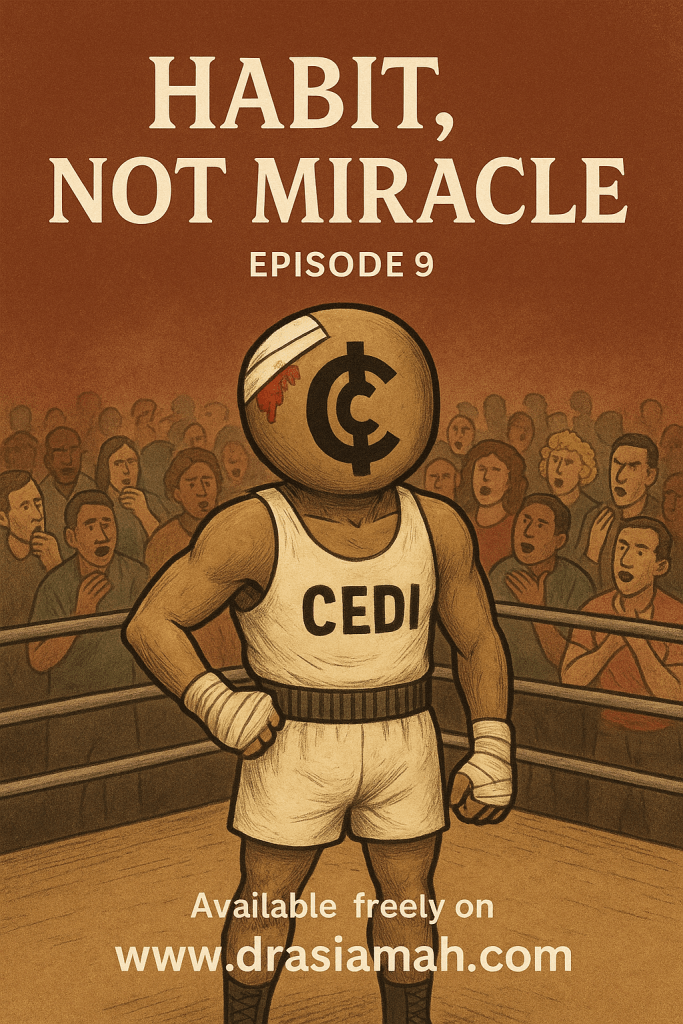
The arena was quieter now. The drums no longer beat like war; the songs of victory had faded into cautious murmurs. Cedi was not sprinting anymore. He was walking—slow, deliberate, with soap stings still fresh on his wound. His steps were heavy, but they were his own, not borrowed from a syringe.
The crowd was divided. Some sulked, disappointed that there were no fireworks or miracle punches.
“Where is the lion we saw last month?” they complained.
Others watched silently, realising for the first time that the real fight was not against the giants in the arena, but against the wounds beneath Cedi’s skin.
Cedi’s Training
Every morning, before the crowd arrived, Cedi practiced. No steroids, no bandages – just discipline.
- He lifted sacks of local rice, learning to depend less on imported bags.
- He sparred with cassava and yam, training his stomach to be filled by what his soil grew.
- He studied the moves of cocoa, not as raw beans but as chocolate and cosmetics, teaching his arms to strike with value addition.
- He jogged alongside industry, sweating to build factories that could meet Euro’s clipboard standards.
It was not glamorous work. There were no cheering trotro mates, no dancing politicians. But slowly, his muscles remembered how to fight without artificial strength.
The Giants Observe
Dollar folded his arms. “Hmm. He is learning to refine oil? This may weaken my hold.”
Pound frowned. “He is training teachers and engineers at home? That might reduce my September harvest.”
Euro adjusted his clipboard. “If his factories begin to meet my standards, he may turn from applicant to competitor.”
The giants did not panic; they were too seasoned for that. But for the first time, they respected Cedi – not for his sprint, but for his discipline.
The Crowd Learns
At first, the people complained. Prices did not fall overnight. Kenkey was still arguing with transport. Waakye was still gossiping with taxes. But as moons turned into seasons, they noticed something strange:
- Tomatoes stopped panicking every time Dollar coughed.
- Cement began to price itself with more confidence.
- Farmers smiled as local rice found loyal customers.
- The fuel pump still frowned, but less often than before.
The people realised: true strength is not a miracle – it is a habit.
The Old Wise Man’s Final Lesson
Under the baobab, the Old Wise Man raised his staff one last time.
“Ahwenepa nkasa.”
(Precious beads do not rattle.)
He explained:
“Real strength is quiet. It does not announce itself with noise or slogans. It is seen in steady prices, in factories that hum daily, in reserves that sleep peacefully, in farmers who plan next season without fear. Cedi must not chase applause anymore; he must build silence that lasts.”
The apprentices bowed. “So, Grandfather, the battle is not won in one miracle?”
He smiled. “No, my children. Miracles impress crowds. Habits build nations.”
Policy Reflection – The Long Lesson of Cedi
- Short-term fireworks don’t feed households. True stability comes from structural reforms: diversifying exports, building local industries, investing in agriculture, and fiscal discipline.
- Habit beats miracle. A currency that steadily strengthens on productivity and buffers is worth more than one that sprints on steroids.
- Quiet progress is real progress. The best economic victories are invisible—when prices stay steady, when reserves quietly grow, when the exchange rate ceases to dominate the evening news.
- Resilience over applause. The goal is not to “beat Dollar, Pound, or Euro” in a sprint but to build an economy that does not collapse when they flex.
Closing Scene
As the sun set over Agyakrom Arena, Cedi stood tall – not roaring, not sprinting, but breathing steadily. The crowd no longer screamed his name, but they watched him with a new kind of respect.
For the first time in years, Cedi was not a miracle patient or a wounded warrior. He was simply a fighter in training – learning that the true battle is not won in the arena but in the habits of the everyday.
And under the baobab, the Old Wise Man whispered to himself:
“Strength is not a miracle. Strength is a habit.”

 Dr. Asiamah's Gazette