Uncategorised

The Life and Trials of Prince Cedi

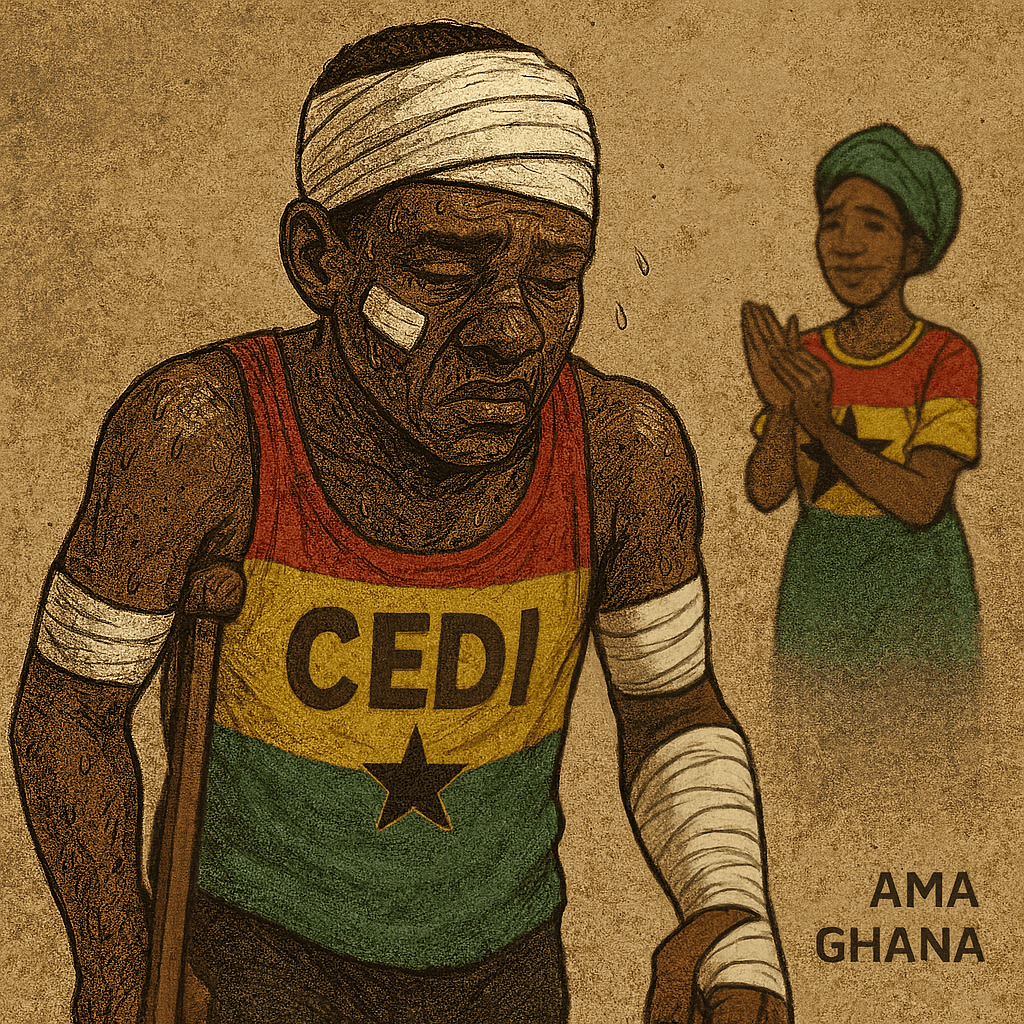
The Cedi is not weak because he was born weak. No — he was born with promise, a child of gold, cocoa, timber, oil, and a people whose sweat could have built empires. He was born a prince.

At birth, his father, Kwame Nkrumah, and his mother, Ama Ghana, held him in the highest esteem. He was clothed in fine linen, stamped with dignity, and introduced to the world as heir to a proud kingdom. He walked shoulder-to-shoulder with the Dollar, the Francs, and even his adopted elder brother, the Pound – who was politely retired once the Cedi came of age.

But this story, like many royal tales, was not to remain one of unbroken glory. The fall of his father, Nkrumah, threw his palace into disarray. Ama Ghana, vulnerable and uncertain, was forced into a string of troubled marriages. Each new husband claimed to love her, yet each one treated young Cedi differently – some with iron fists, others with false promises.

And so begins the tragic and wandering tale of Prince Cedi.


The 1960s: A Prince is Born

The early years were full of hope. At independence, the Ghanaian economy glittered with foreign reserves, robust cocoa exports, and national pride. The birth of the Cedi in 1965 was a celebration of sovereignty itself – a declaration that Ghana would no longer walk in the shadow of the British Pound.

Nkrumah, the proud father, wanted his son to be a symbol of independence and self-reliance. But the young Cedi’s childhood was cut short. The coup of 1966 left him fatherless, his household broken, and his destiny in the hands of guardians who neither understood nor cared for him.


The 1970s: The Vagabond Years

Ama Ghana’s remarriages during this decade brought turmoil to the Cedi’s adolescence. His new fathers said he was too pampered. They ordered him to “adjust” – which in economic language meant devaluation. For the first time, his princely robes were stripped, and his dignity was questioned.

Cedi, restless and abandoned, turned vagabond. He was often spotted playing in the shadows of the black market, mingling with abochi boys who traded him at prices his own mother disapproved of. The palace guards (government officials) would chase him down the streets of Accra, but each time they caught him, he slipped away again.

The official home (the banks) and the street home (the black market) no longer agreed on his worth. A prince who once dined with the Dollar was now mocked at chop bars and trotro stations.


The 1980s: The International School of Hard Knocks

By the 1980s, Ama Ghana’s marriage to military fathers had failed. They had neither the patience nor the wisdom to raise a fragile son. Out of desperation, they enrolled the Cedi in a foreign “international school” run by strict headmasters – the IMF and the World Bank.

There, Cedi met the true bullies of the playground: Dollar, Yen, and Pound. They mocked him daily. The headmasters insisted on “discipline” – structural adjustment programs, austerity, and liberalization. Cedi was told to sit quietly, eat less, and obey. He was put on medication (currency reforms) but given no food (production support).

He grew lean, frail, and unrecognizable. His own mother, Ama Ghana, often wept: “Is this the son I bore with such promise?”

The once-princely Cedi, starved and bullied, developed an inferiority complex. He began to believe he was truly worthless.


The 1990s: The Struggling Youth

The 1990s brought democracy, but democracy alone could not feed him. His new stepfathers came in suits and ties, promising care and stability, but their love was shallow. They opened Ghana’s borders wide, encouraging imports while Cedi still had no strength to compete.

As factories closed and jobs disappeared, Cedi became more fragile. He worked odd jobs in the informal sector – remittances from abroad, small-scale trade, and aid inflows kept him alive. His classmates – the Dollar and the Euro (a new student who joined in 1999) – grew taller and stronger, while Cedi remained stunted.


The 2000s: Cosmetic Surgery

In the 2000s, his stepfather came with a bright idea: plastic surgery. They said his frail, disfigured body could be rebranded. A “re-denomination” was carried out in 2007, lopping off four zeros. His parents proudly proclaimed: “The value is the same.”

For a while, the new look fooled the world. Cedi looked sleek, confident, even modern. He strutted through markets and banking halls as though reborn. His West African friends – the Naira and the CFA Franc – looked at him with a mix of envy and pity.

But cosmetic surgery could not cure his inner weakness. He still had no stamina. Each time the economy trembled – from oil price shocks to fiscal indiscipline – his bandages came loose.


The 2010s: The Sickly Adult

By the 2010s, Cedi was an adult, but one plagued with chronic illness. Inflation gnawed at him like a parasite. Governments tried steroids – Eurobonds, donor inflows, short-term fixes – but the effect always wore off.

He lived from crisis to crisis, bailout to bailout, plaster to plaster. Each year, Ama Ghana would cheer him on at the Independence parade, hoping this would be the year her son would rise. But each year, disappointment followed.


The 2020s: Pandemic, War, and the ICU

The 2020s brought global shocks: a pandemic, supply chain disruptions, and war in Ukraine. Cedi was rushed to the ICU. He gasped for breath as inflation soared past 50% in 2022. The Dollar, smug as ever, mocked him in public.

Governments tried quick fixes: gold-for-oil schemes, central bank interventions, and frantic borrowing. They put Cedi on life support, but the bandages were visible to all. His weakness was not of birth, but of neglect, misuse, and betrayal.


The Philosophy of Cedi’s Struggle

The story of Cedi is not just the tale of a currency. It is the parable of Ghana itself. For in him lies the reflection of a nation that has danced between promise and betrayal, between pride and dependency.

The Cedi is not inherently weak. He was born a prince, with the resources of a kingdom behind him. But every marriage of Ama Ghana to fickle stepfathers, every neglect of discipline, every short-sighted policy, has left him wounded.

Through it all, Ama Ghana, the ever-supportive mother, still sits in the stands, cheering her son on. She sees his scars, but she has not given up.

The fight of the Cedi is the fight of Ghana. And in that truth lies the final lesson:

“No plaster lasts forever. No steroid can replace strength. Only wisdom, honesty, and discipline can restore lost glory. Until then, the fight continues – and each jab is a reminder that the value is never the same.”
Ghana News, Ghana's Political Economy, Ghanaian Politics, Politics, Uncategorised

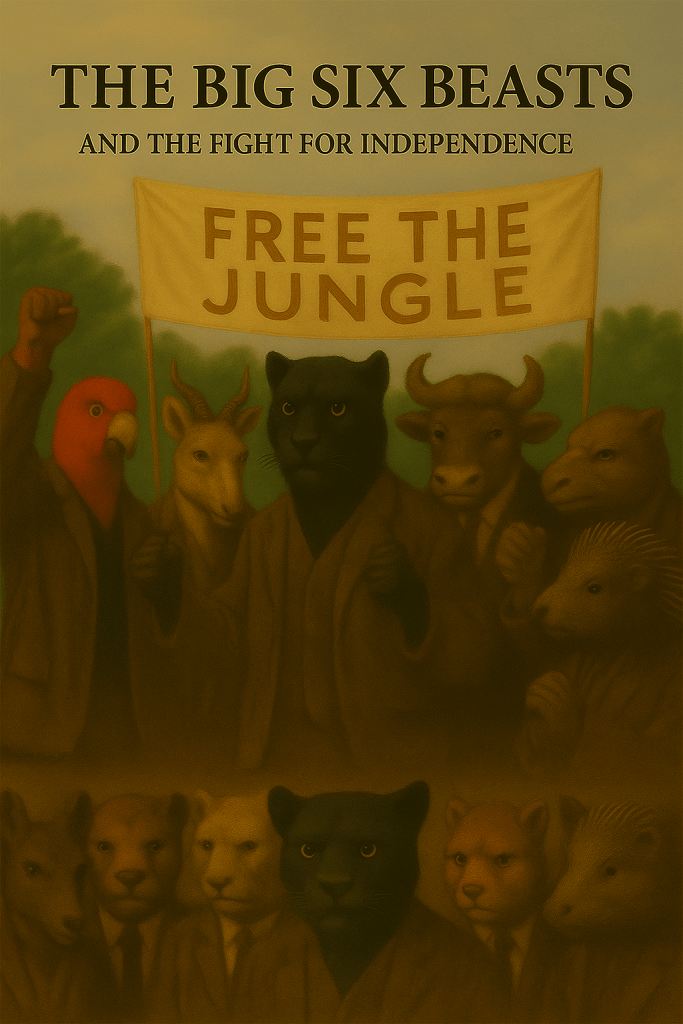
Episode 1: In the Beginning… There Was a Jungle

Every jungle has a history. But not every beast remembers.

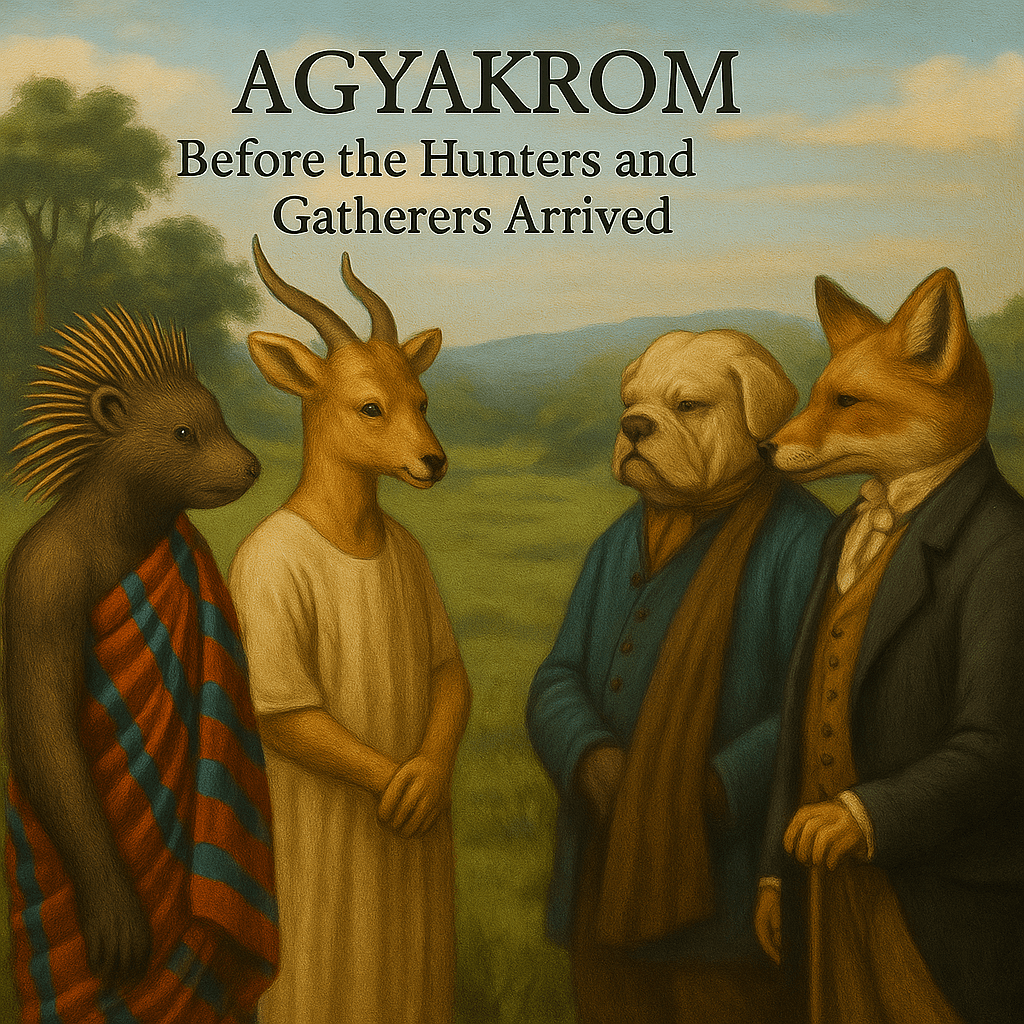
Long before thrones, ballots, slogans, and scandals, there was a vast land in the western belly of the African continent – a place of gold, rivers, thick forests, and proud beasts.

They called it Agyakrom.

It was not yet a republic.

It was not yet even a country.

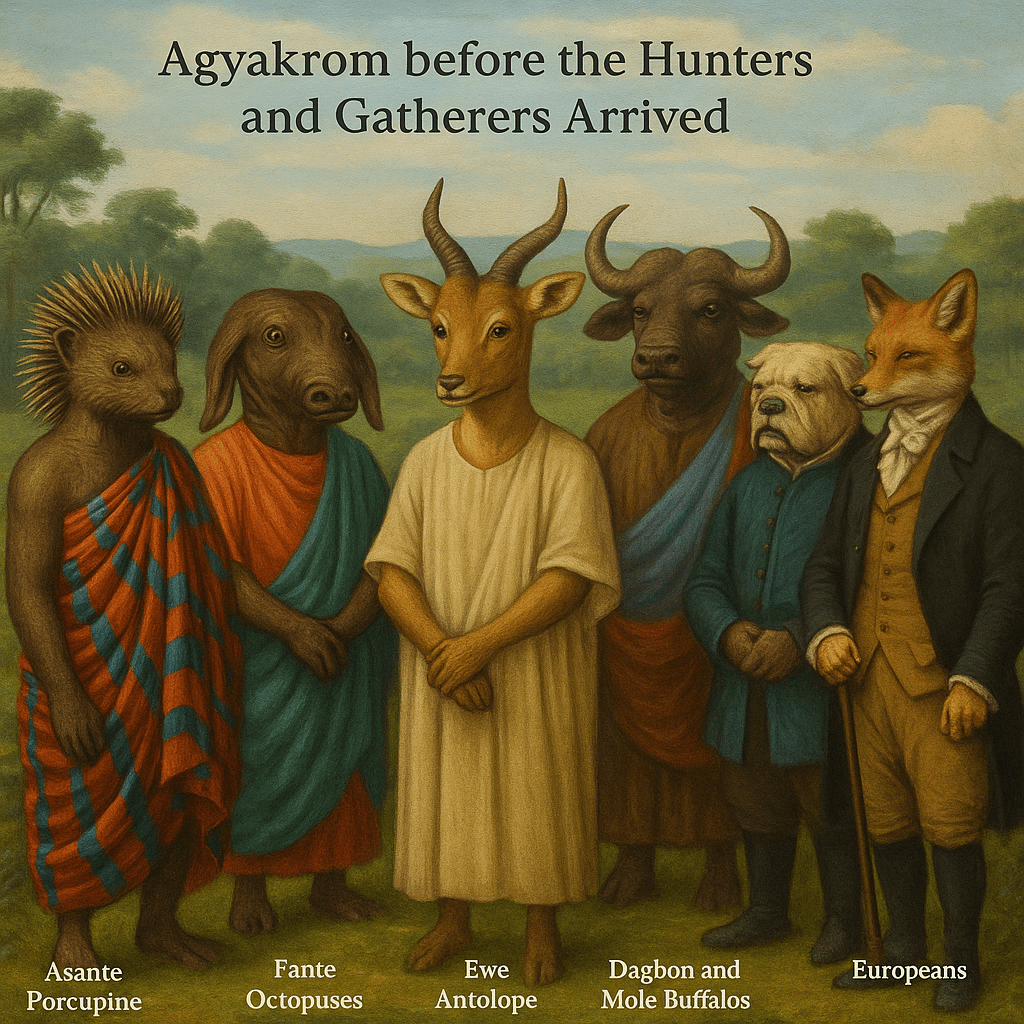
It was a patchwork of powerful animal clans – Asante Porcupines, Ewe Antelopes, Mole-Dagbani Buffalos, Fante Octopuses, Ga jackals, and many more – each with their own kings, traditions, markets, shrines, and seasonal drumbeats.

They lived not in utopia, but in order.

The rivers flowed with rhythm.

The forests echoed with proverbs.

The elders ruled with stools, not scrolls.

And then – the hunters came.

The Coming of the Hunters and Gatherers

No one knows exactly when the first Hunter ship hit the shores. But the river whispers tell of the time when strange, light-skinned creatures – two-legged, clothed in iron and greed – arrived with crosses, coins, and chains.

They came bearing gifts: mirrors, rum, muskets, and the Holy Scroll.

But beneath their cloaks were ledgers.

The jungle called them The Gatherers.

Because that’s what they did.

They gathered:

                  •               Gold from the Lion caves,

                  •               Ivory from the forest bones,

                  •               Palm oil from the Monkey Groves,

                  •               And worst of all, beasts themselves – from the weakest cubs to the strongest buffaloes.

They said they had come to civilise.

But civilisation came with shackles.

For over three hundred rainy seasons, Agyakrom watched its children carried across oceans.

And when the chains were finally lifted, the Gatherers returned – not with whips, but with Rule.

The Jungle Becomes a Colony

They called it a protectorate.

Then a colony.

Then a gold coast – not because of the coast, but because of the gold.

They drew borders like scratch marks on a termite map.

They made laws in languages no beast spoke.

They crowned chiefs they could control.

They introduced currency, courts, and new religion – leaving confusion and conversion in equal measure.

The Jungle Parliament? Replaced by District Commissions.

The beast customs? Replaced by colonial codes.

The jungle’s soul? Traded for infrastructure and flags.

Agyakrom, the free land of many tribes, became a colony.

And the beasts began to forget they were once sovereign.

But as every wise monkey knows:

You can cage a lion, but you cannot silence the growl forever.

The Rise of the Roaring Beasts

By the early 20th century, the jungle began to stir.

Young beasts – some educated abroad, some trained in the colonial classrooms, others shaped by the fireside wisdom of their elders – began to ask dangerous questions.

“Why must we fetch water for their baths while our rivers run dry?”

“Why must our cocoa feed their children, but not ours?”

The great independence struggle was born.

JUNGLE WISDOM OF THE DAY

A Beast that forgets where it came from will never know where it is going

Watch Out for Episode 2: The Struggle for Independence

Uncategorised

The NDC’s 24-Hour Economy: A Time-Turner Without a Manual?

Ghana’s political atmosphere is sizzling as the countdown to election day narrows to mere hours. Campaign slogans, jingles, and promises are flying faster than trotro drivers on empty roads, but one stands out for its audacity: the opposition National Democratic Congress’s (NDC) promise of a 24-hour economy. Bold? Certainly. Thought out? Well, let’s just say the devil, as always, is in the details – or the lack thereof.

To be fair, the idea of a 24-hour economy isn’t inherently ridiculous. After all, cities like New York and Tokyo thrive on round-the-clock activity. The promise of bustling factories, buzzing marketplaces, and street food vendors selling kelewele under neon lights has a certain allure. Who wouldn’t want to double the economic activity, reduce unemployment, and make Ghana a beacon of efficiency on the continent? 

But here’s where things get interesting. While the idea could be sold as a visionary framework – a long-term goal with well-laid plans and phased implementation – the NDC has pitched it as though it’s a policy ready to be executed after 7th January, 2025. Their pitch? Businesses willing to operate at night will receive subsidies and incentives. Sounds straightforward until you start asking questions.

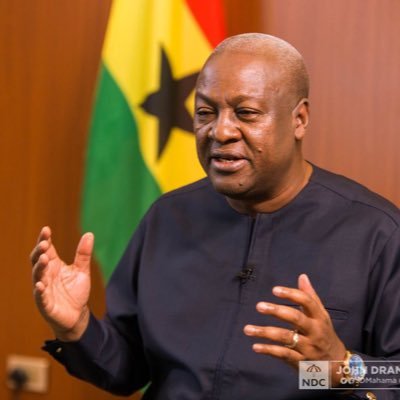
And the BBC did just that. Former President John Mahama, the NDC’s flagbearer, found himself in a tight spot when asked about the cost of this grand plan. His response? A classic case of political improvisation. “You can’t put a cost on it immediately,” he said, prompting the BBC interviewer to quip, “Then it’s a gamble?” Ouch. For a man vying to regain the presidency, this wasn’t the sort of soundbite you want playing on loop 48 hours before ballots are cast.

Let’s unpack this “gamble.” Running a 24-hour economy involves more than giving night-shift businesses a few tax breaks. It requires massive investments in infrastructure: reliable electricity (hello, ECG, can we talk?), robust public transportation to move workers at odd hours, enhanced security to combat the inevitable rise in night-time crime, and even a cultural shift in how Ghanaians perceive work and leisure. And those subsidies? Somebody’s paying for them – spoiler alert: it’s us, the taxpayers.

But perhaps the most glaring omission in the NDC’s pitch is the human factor. Who is staffing this 24-hour economy? Are there enough workers ready to transition to night shifts? Will the incentives for businesses trickle down to fair wages for employees who sacrifice sleep and family time for the graveyard shift? These questions hang like Kasoa’s infamous traffic smog – visible but unanswered.

And then there’s the small matter of timing. Ghana’s economy is already stretched thin. Inflation is soaring, the cedi is on life support, and public trust in governance is shaky at best. In this context, promising a 24-hour economy without a clear roadmap is like trying to convince an athlete in critical condition to start training for the Olympics. Ambitious? Sure. Realistic? Not so much.

Ultimately, the problem isn’t the concept itself. A 24-hour economy could work – if introduced gradually, with clear goals and adequate resources. The real tragedy here is that the NDC has missed a golden opportunity. Instead of focusing on the policies that could build the foundation for such an economy – improving energy supply, boosting digital infrastructure, enhancing security, or reforming labor laws – they’ve chosen to dangle the 24-hour economy as an enticing carrot before a weary electorate. They’ve made the promise the headline, rather than the vision.

As election day nears, one can’t help but wonder if this promise will resonate with voters or serve as a stepping stone for deeper conversations about Ghana’s economic future. While the 24-hour economy feels ambitious and perhaps overly simplified in its current form, it holds potential as a bold vision that could ignite a shift in how we think about economic growth. If voters can look beyond the catchy headline and push for more robust policies to back this idea, it might just become the catalyst for meaningful transformation. Ghana has always thrived on the audacity of hope, and perhaps this promise, even in its imperfections, could spark the kind of dialogue and momentum needed to move the nation forward. After all, big dreams often pave the way for big changes.

Uncategorised

John Dramani Mahama: Infrastructural Feats, Economic Challenges, and 2024 Redemption

In the annals of Ghana’s political history, the name John Dramani Mahama evokes a sense of paradox. His presidency from 2012 to 2016 was marked by a duality that encapsulates the essence of leadership and its trials. On one hand, Mahama’s tenure was a period of significant infrastructural achievements, a testament to his vision for a modernised Ghana. On the other, the spectre of “dumsor” (persistent power outages) and subsequent economic hardships overshadowed his accomplishments, casting a long shadow over his political legacy. As the 2024 elections approach, Mahama stands at the crossroads of redemption, seeking to leverage his infrastructural feats to reclaim the mantle of leadership.

Mahama’s presidency began with a promise of transformation. Infrastructure became the cornerstone of his administration, with a vision to develop roads, hospitals, schools, and energy projects. Under his leadership, Ghana witnessed the construction of several key infrastructures, including the Ridge Hospital, the University of Ghana Medical Center, and numerous road networks. These projects were not mere facades of progress; they were critical developments aimed at enhancing the nation’s capacity and service delivery. For instance, the Ridge Hospital was upgraded to a state-of-the-art facility, providing much-needed healthcare services to a growing population. The construction of Terminal 3 at the Kotoka International Airport, the expansion of the Tema Port and the construction of the Kwame Nkrumah Interchange further illustrated Mahama’s commitment to infrastructure as the backbone of economic growth.

However, Mahama’s infrastructural achievements were significantly marred by the persistent and severe power outages, known locally as “dumsor,” which plagued Ghana during his presidency. Dumsor became a daily reality for many Ghanaians, affecting households, businesses, and the overall economy. The energy crisis was not merely an inconvenience; it had profound implications for industrial production, small businesses, and the quality of life of ordinary citizens. Industries faced increased production costs due to reliance on alternative power sources, and many small businesses were forced to close, unable to cope with the frequent and prolonged power cuts. This period of darkness, both literal and metaphorical, overshadowed Mahama’s infrastructural strides and became a symbol of his administration’s perceived incompetence.

Economically, Mahama’s tenure was further complicated by a downturn that exacerbated public discontent. High inflation rates, a depreciating currency, and rising unemployment painted a grim picture of the Ghanaian economy. The fiscal deficit ballooned, and public debt soared, leading to an International Monetary Fund (IMF) bailout in 2015. For many Ghanaians, these economic hardships were a direct result of poor governance and mismanagement, fueling a narrative of incompetence that Mahama’s opponents were quick to exploit. This economic narrative, combined with the energy crisis, created a powerful and negative perception that proved difficult to shake off.

In the 2016 elections, Mahama faced a resounding defeat to Nana Akufo-Addo of the New Patriotic Party (NPP). Akufo-Addo’s campaign capitalised on the electorate’s frustration with the economic and energy crises, promising a new dawn of prosperity and stability. The NPP’s victory was seen as a referendum on Mahama’s presidency, with many voters rejecting what they perceived as a legacy of failure. Despite this, Mahama remained a significant figure in Ghanaian politics, continuing to influence discourse and policy within the National Democratic Congress (NDC).

The 2020 elections offered Mahama a chance at redemption. Running once more against Akufo-Addo, Mahama campaigned on his record of infrastructure while promising to rectify past mistakes. The election was fiercely contested, but Mahama ultimately fell short, losing narrowly. The result, however, indicated that a substantial portion of the electorate still resonated with his message and recognized his efforts in nation-building. This close contest set the stage for the 2024 elections, where Mahama seeks to leverage his infrastructural legacy as a key component of his comeback strategy.

Mahama’s vision for a 24-hour economy is central to his 2024 campaign. This ambitious plan aims to transform Ghana into a nation that never sleeps, with continuous economic activities around the clock. The idea is to boost productivity, create jobs, and stimulate economic growth by maximising the use of time and resources. Mahama argues that a 24-hour economy would attract investments, improve public services, and enhance the quality of life for Ghanaians. The concept, while appealing in its potential to revolutionize the economy, faces significant challenges in implementation. It requires substantial improvements in infrastructure, security, and labour regulations to ensure that the workforce is protected and that the necessary services are available around the clock.

Critics, however, remain sceptical of Mahama’s ability to deliver on such grand promises. They point to his previous tenure, where despite notable infrastructural developments, the economy suffered. They argue that the issues of dumsor and economic mismanagement could resurface, undermining the feasibility of a 24-hour economy. Moreover, the nickname “Mahama the Incompetent,” coined by his opponents, continues to linger, serving as a reminder of the challenges he faced during his presidency. Overcoming this negative perception is a significant hurdle for Mahama as he seeks to regain the trust of the electorate.

To counter these criticisms, Mahama has focused on presenting a detailed and pragmatic plan for his 24-hour economy vision. He emphasises the importance of reliable energy supply, improved transportation networks, and enhanced security measures. Mahama argues that his previous infrastructural projects laid the groundwork for this transformation and that lessons learned from past mistakes will guide his approach. He highlights successful 24-hour economies in other countries as models, suggesting that Ghana can adapt similar strategies to its unique context.

Furthermore, Mahama has sought to address the economic concerns by proposing measures to stabilise the economy and promote growth. These include fiscal discipline, investment in key sectors such as agriculture and manufacturing, and initiatives to support small and medium-sized enterprises. Mahama’s campaign also focuses on social policies aimed at reducing poverty, improving education, and expanding healthcare services. By presenting a comprehensive and multifaceted approach, Mahama aims to convince voters that he has the vision and capability to lead Ghana towards a brighter future.

The challenge for Mahama, however, lies not only in articulating his vision but also in convincing a sceptical electorate that he can deliver on his promises. The memory of dumsor and economic hardship remains fresh in the minds of many Ghanaians. Overcoming this scepticism requires a combination of effective communication, concrete policy proposals, and a demonstration of competence and leadership. Mahama’s ability to connect with voters on a personal level, addressing their concerns and aspirations, will be crucial in his campaign.