Uncategorised

The Life and Trials of Prince Cedi

The Cedi is not weak because he was born weak. No — he was born with promise, a child of gold, cocoa, timber, oil, and a people whose sweat could have built empires. He was born a prince.

At birth, his father, Kwame Nkrumah, and his mother, Ama Ghana, held him in the highest esteem. He was clothed in fine linen, stamped with dignity, and introduced to the world as heir to a proud kingdom. He walked shoulder-to-shoulder with the Dollar, the Francs, and even his adopted elder brother, the Pound – who was politely retired once the Cedi came of age.

But this story, like many royal tales, was not to remain one of unbroken glory. The fall of his father, Nkrumah, threw his palace into disarray. Ama Ghana, vulnerable and uncertain, was forced into a string of troubled marriages. Each new husband claimed to love her, yet each one treated young Cedi differently – some with iron fists, others with false promises.

And so begins the tragic and wandering tale of Prince Cedi.


The 1960s: A Prince is Born

The early years were full of hope. At independence, the Ghanaian economy glittered with foreign reserves, robust cocoa exports, and national pride. The birth of the Cedi in 1965 was a celebration of sovereignty itself – a declaration that Ghana would no longer walk in the shadow of the British Pound.

Nkrumah, the proud father, wanted his son to be a symbol of independence and self-reliance. But the young Cedi’s childhood was cut short. The coup of 1966 left him fatherless, his household broken, and his destiny in the hands of guardians who neither understood nor cared for him.


The 1970s: The Vagabond Years

Ama Ghana’s remarriages during this decade brought turmoil to the Cedi’s adolescence. His new fathers said he was too pampered. They ordered him to “adjust” – which in economic language meant devaluation. For the first time, his princely robes were stripped, and his dignity was questioned.

Cedi, restless and abandoned, turned vagabond. He was often spotted playing in the shadows of the black market, mingling with abochi boys who traded him at prices his own mother disapproved of. The palace guards (government officials) would chase him down the streets of Accra, but each time they caught him, he slipped away again.

The official home (the banks) and the street home (the black market) no longer agreed on his worth. A prince who once dined with the Dollar was now mocked at chop bars and trotro stations.


The 1980s: The International School of Hard Knocks

By the 1980s, Ama Ghana’s marriage to military fathers had failed. They had neither the patience nor the wisdom to raise a fragile son. Out of desperation, they enrolled the Cedi in a foreign “international school” run by strict headmasters – the IMF and the World Bank.

There, Cedi met the true bullies of the playground: Dollar, Yen, and Pound. They mocked him daily. The headmasters insisted on “discipline” – structural adjustment programs, austerity, and liberalization. Cedi was told to sit quietly, eat less, and obey. He was put on medication (currency reforms) but given no food (production support).

He grew lean, frail, and unrecognizable. His own mother, Ama Ghana, often wept: “Is this the son I bore with such promise?”

The once-princely Cedi, starved and bullied, developed an inferiority complex. He began to believe he was truly worthless.


The 1990s: The Struggling Youth

The 1990s brought democracy, but democracy alone could not feed him. His new stepfathers came in suits and ties, promising care and stability, but their love was shallow. They opened Ghana’s borders wide, encouraging imports while Cedi still had no strength to compete.

As factories closed and jobs disappeared, Cedi became more fragile. He worked odd jobs in the informal sector – remittances from abroad, small-scale trade, and aid inflows kept him alive. His classmates – the Dollar and the Euro (a new student who joined in 1999) – grew taller and stronger, while Cedi remained stunted.


The 2000s: Cosmetic Surgery

In the 2000s, his stepfather came with a bright idea: plastic surgery. They said his frail, disfigured body could be rebranded. A “re-denomination” was carried out in 2007, lopping off four zeros. His parents proudly proclaimed: “The value is the same.”

For a while, the new look fooled the world. Cedi looked sleek, confident, even modern. He strutted through markets and banking halls as though reborn. His West African friends – the Naira and the CFA Franc – looked at him with a mix of envy and pity.

But cosmetic surgery could not cure his inner weakness. He still had no stamina. Each time the economy trembled – from oil price shocks to fiscal indiscipline – his bandages came loose.


The 2010s: The Sickly Adult

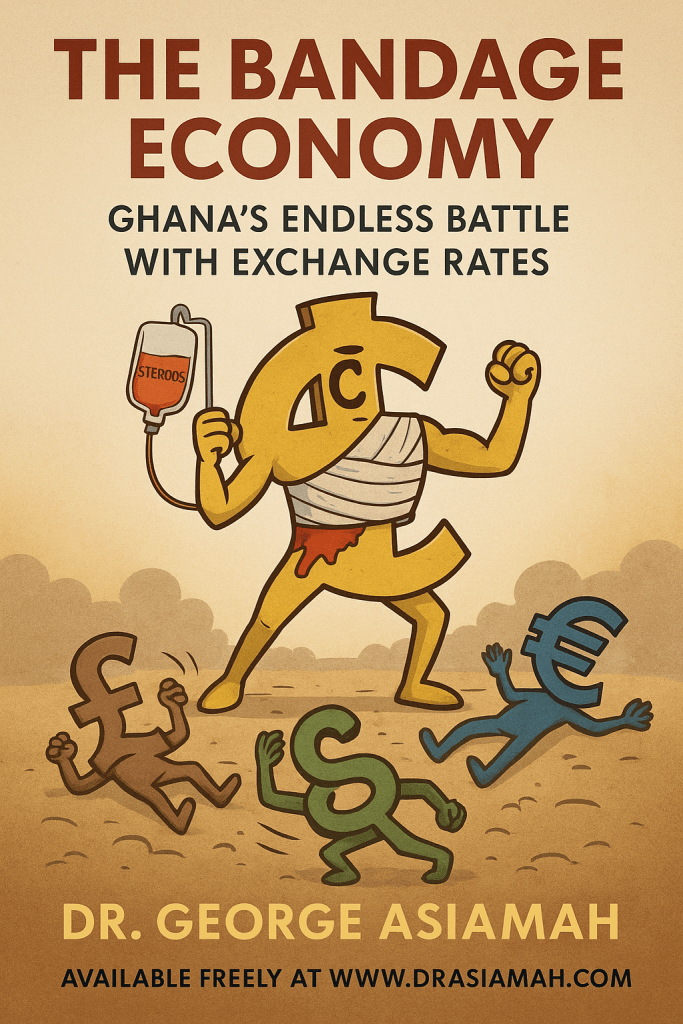
By the 2010s, Cedi was an adult, but one plagued with chronic illness. Inflation gnawed at him like a parasite. Governments tried steroids – Eurobonds, donor inflows, short-term fixes – but the effect always wore off.

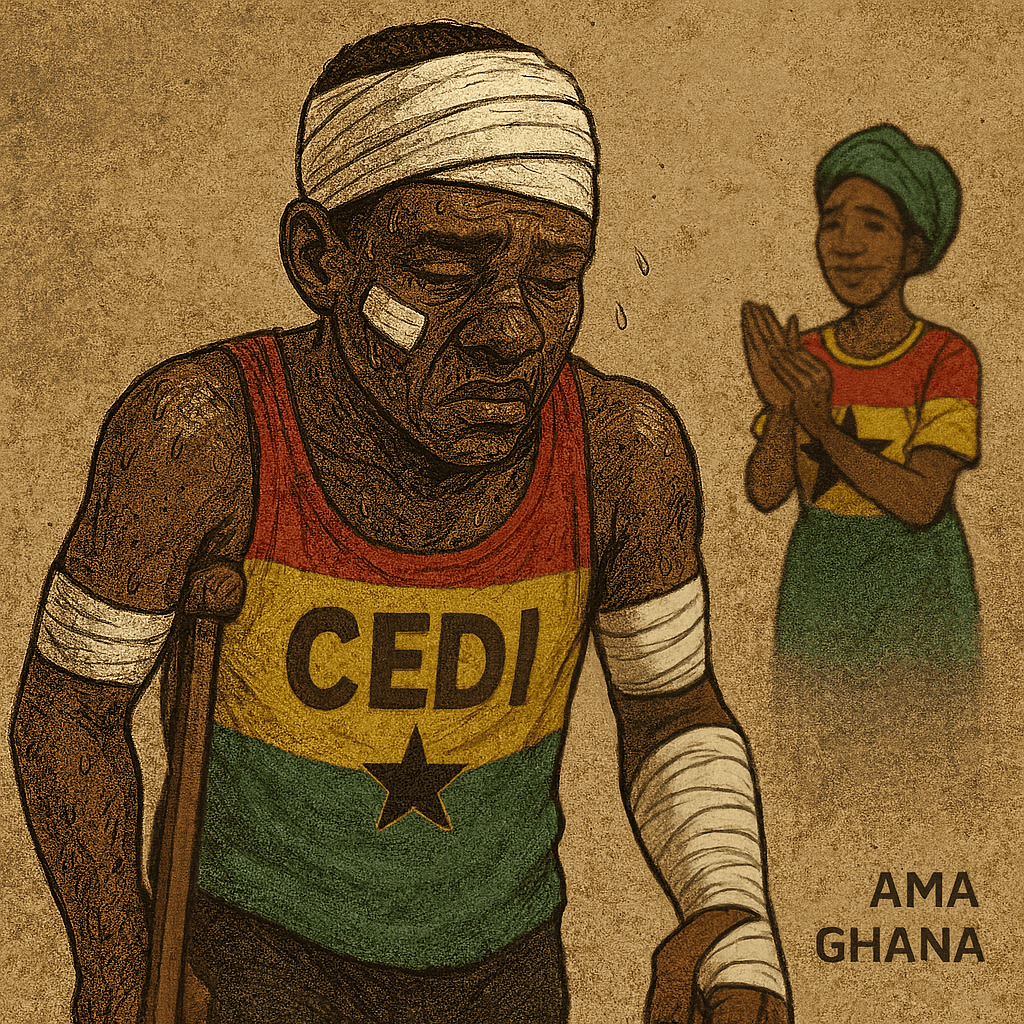
He lived from crisis to crisis, bailout to bailout, plaster to plaster. Each year, Ama Ghana would cheer him on at the Independence parade, hoping this would be the year her son would rise. But each year, disappointment followed.


The 2020s: Pandemic, War, and the ICU

The 2020s brought global shocks: a pandemic, supply chain disruptions, and war in Ukraine. Cedi was rushed to the ICU. He gasped for breath as inflation soared past 50% in 2022. The Dollar, smug as ever, mocked him in public.

Governments tried quick fixes: gold-for-oil schemes, central bank interventions, and frantic borrowing. They put Cedi on life support, but the bandages were visible to all. His weakness was not of birth, but of neglect, misuse, and betrayal.


The Philosophy of Cedi’s Struggle

The story of Cedi is not just the tale of a currency. It is the parable of Ghana itself. For in him lies the reflection of a nation that has danced between promise and betrayal, between pride and dependency.

The Cedi is not inherently weak. He was born a prince, with the resources of a kingdom behind him. But every marriage of Ama Ghana to fickle stepfathers, every neglect of discipline, every short-sighted policy, has left him wounded.

Through it all, Ama Ghana, the ever-supportive mother, still sits in the stands, cheering her son on. She sees his scars, but she has not given up.

The fight of the Cedi is the fight of Ghana. And in that truth lies the final lesson:

“No plaster lasts forever. No steroid can replace strength. Only wisdom, honesty, and discipline can restore lost glory. Until then, the fight continues – and each jab is a reminder that the value is never the same.”
Blog Series, Everyday Life, Ghana's Political Economy, Ghanaian Politics, Politics, The Bandage Economy, UK Politics

Episode 2: The Bandage Miracle

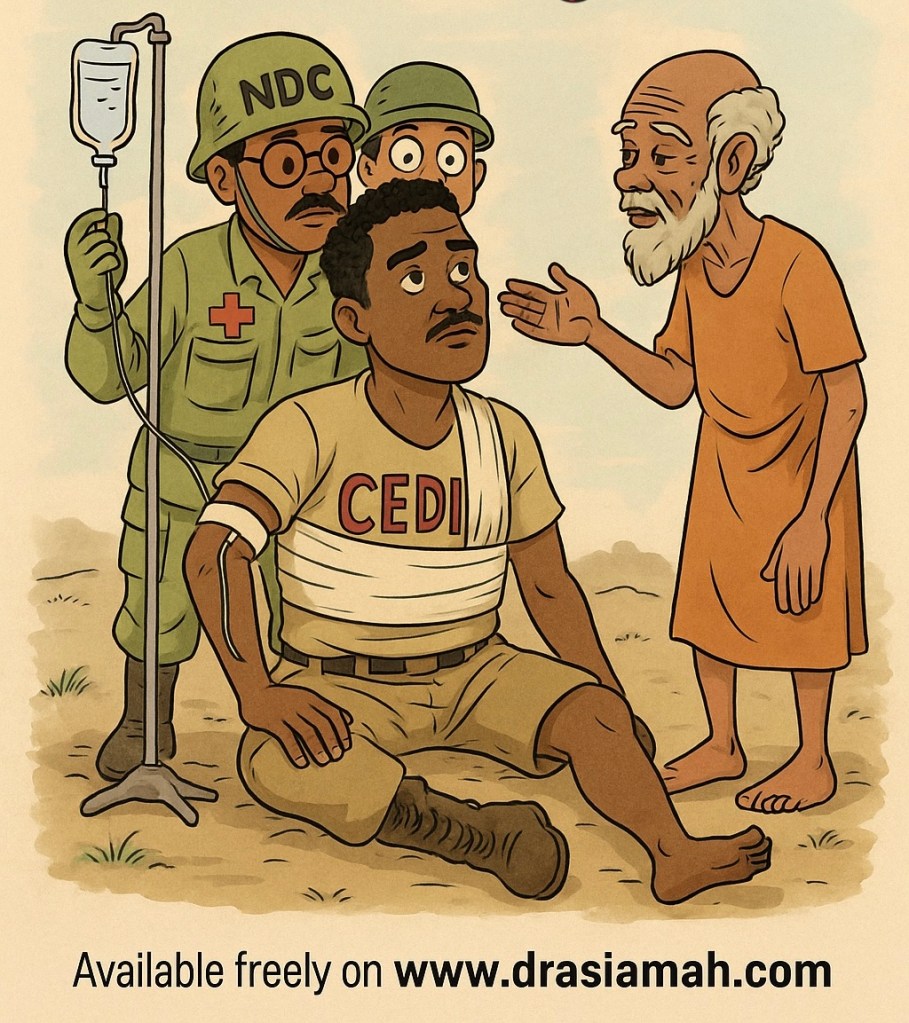
At dawn the sirens wailed and the NDC Brigade arrived – not with sabres but with stethoscopes, calculators, and a trolley that squeaked like a budget line. They found Cedi facedown, chest heaving, eyes cloudy from Dollar’s oil hooks, Pound’s spare‑parts jabs, and Euro’s paperwork chokehold.

“Vitals?” the chief medic asked.

“Pulse erratic. Confidence low. Reserves anaemic. Imports demanding transfusion,” replied the junior medic, thumbing a ledger as if it were a heartbeat monitor.

“Hmm,” the chief said, rolling up their sleeves. “We cannot build a new ribcage on the battlefield, but we can stop the bleeding and get him standing. The crowd needs a fighter, not a eulogy.”

They produced a bandage so wide it could wrap a stadium – tight enough to quiet a scream – and an ampoule labelled Booster (the kind that makes a tired goat chase a Land Cruiser). One jab. Two. A whisper of prayers and policy. The squeaky trolley exhaled.

Cedi twitched.

Another ampoule – this one called Confidence (side effects: swagger, selective hearing, short poems on social media).

Cedi blinked, sat up, spat dust, and – before anyone could recite a fiscal rule – leapt to his feet.

The arena erupted.

“Cedi! Cedi! Cedi!” The kelewele sellers beat ladles on pans; the trotro mates whistled a high‑pitch exchange rate. Even tomatoes – usually stoic – blushed a little.

Cedi tested his limbs like a man fresh from a long dream. He flexed. The bandage hugged his ribs. The Booster burned hymns in his veins. He sprinted.

First, he feinted at Dollar – a quick combination of auctions and attitude. Dollar stumbled, surprised that this same patient was now a pursuer. Then Cedi pirouetted and slapped Pound so neatly that Pound’s monocle somersaulted into the dust. Euro – never theatrical – adjusted his stack of standards but still caught a neat hook that sent three of his smaller allies scrambling for their compliance manuals.

For a moment, even the giants looked… mortal.

“Wonders shall never end!” a trader shouted, waving an invoice like a victory flag.

“See our boy – fresh like new salary!” a teacher laughed, already calculating what his arrears could buy if this miracle held.

From under the bandage, a dull ache cleared its throat. I’m still here, it said. But the drums were louder than pain, and Cedi – full of Confidence – could finally hear himself think louder than the crowd.

He prowled the ring.

Dollar scowled, nursing his jaw. “Enjoy your lap, small boy. Invoices don’t forget.”

Pound retrieved his monocle, breathing like a man who had just remembered colonialism had a returns policy. “Splendid sprint. We shall… reconcile later.”

Euro stacked his papers again – pharma, machinery, wheat – then said, softly: “Imports due is a bell that always rings.”

Cedi only grinned. The Boosters sang revival tunes. He felt strong enough to head‑butt a balance of payments.

Around the ring, Makola Market lifted one eyebrow.

Fuel sniffed. Nice footwork. Do I smell refinery discounts? No? Then I shall remain an elder.
Cement rotated its baggy shoulders. Exchange rate is cousin to my price, not my father.
Tomatoes adjusted their headscarves. We came by truck; truck speaks the language of diesel; diesel does not read hashtags.

Still, the mood was carnival. For a few glorious days, the story was simple: Cedi had fallen; Cedi had risen. The medics were geniuses. The giants had finally been taught manners. The memes were sweet; the thread counts were high.

But in the shade of the scoreboard, two apprentices of the Old Wise Man argued quietly.

“Miracle!” said the first. “Look how fast he runs.”

“Pain management,” said the second. “Look how tight the bandage is.”

They carried their debate to the baobab, where the Old Wise Man was mending a fishing net of proverbs.

“Grandfather,” they said, “is this healing?”

He smiled the patient smile of one who has buried several booms and three busts. “Listen, my children. A man with pepper in his veins can outrun a cheetah—but it is not speed; it is fire. A house painted gold will sparkle in the sun—but knock the wall, and you will meet its mud. If you hush the drum with palm oil, it will play a soft song; when harmattan comes, it will crack all the same.”

They frowned. “So…no miracle?”

“Miracles exist,” he said. “But budgets prefer arithmetic.”

Back in the ring, Cedi continued to dazzle. He threw a flurry at Dollar (call it guided auctions), feinted at Pound (call it administrative tightening), and smiled at Euro through a priority‑imports wink. Each move bought space, time, and – most valuable of all – silence from the panic that ruins weeks in a day.

The chief medic, watching from the corner, scribbled notes:

  • Stabilise the patient: reduce visible volatility; restore breath.
  • Buy time: signal discipline; calm expectations; tidy the rumour mill.
  • Manage the optics: markets eat with their eyes first.

Then, as the sun tilted, the junior medic whispered, “Chief, the vial box…”

“I know,” the chief said.

They both looked at the bandage. Under it, heat gathered like unasked questions.


Proverb of the Day:

“Sɛ wopɛsɛ wo kum aboa a, bɔ ne ti, na ɛnyɛ ne kotodwe.”
(If you intend to bring down an animal, aim for the head, not the knee.)

Meaning: Go for the root cause; don’t only stun the symptoms.


Policy Reflection – What the “Bandage” and “Booster” usually mean

The Bandage Miracle is the toolkit of short‑term forex stabilisation. It is useful – sometimes essential – on a battlefield. But it is not the surgery. Typical “bandage/booster” moves include:

  1. Heavy FX interventions (central bank sells dollars to market): calms spikes but burns reserves if not paired with real fixes.
  2. Forward auctions / tighter FX windows: guides price discovery; squeezes speculation – can also squeeze genuine importers if rationing bites.
  3. Cash‑flow steroids: one‑off inflows (IMF/BOP tranches, syndicated loans, commodity pre‑financing) that fatten reserves quickly – Powerful, but with repayment footprints.
  4. Administrative tightening: documentation checks, surrender requirements, limits on certain outflows—slows leaks; risks pushing demand to side streets.
  5. Interest‑rate signalling & liquidity mops: strengthen the carry to cool demand for foreign currency – helps the rate, but financing costs bite SMEs.
  6. Import prioritisation: channel scarce FX to essentials (fuel, medicines, inputs) – wise triage; also admits we can’t feed every appetite today.

Why it feels like a miracle: expectations flip fast. Fear goes quiet. The rate retreats. Headlines clap. But…

  • Prices don’t fall in a straight line. Inventories were bought at the old rate; fuel taxes and margins exist; transport costs are sticky; wholesalers hedge by memory.
  • Reserves are not rivers. If the surgery (exports, productivity, fiscal diet) doesn’t follow, the bandage wets through.
  • Credibility clocks tick. Markets forgive emergency medicine; they punish addiction.

So yes – stanch the bleeding. Wrap the ribs. Inject composure. But then pick up the scalpel for the real work: trimming deficits, growing exports, adding value at home, building buffers when cocoa smiles and gold winks. The crowd loves a sprint; stability is marathon grammar.

From the baobab, the Old Wise Man’s voice drifted back into the cheering:

Bandage is mercy. Booster is breath. But the head of the animal is the structure: what you make, what you sell, how you spend, how you save. Miss the head, and you will chase the tail until evening.”

Episode One: The Fall of the Cedi

Episode Three: The Giants and Their Taunts

Blog Series, Ghana News, Ghana's Political Economy, Ghanaian Politics, Political Satire & Fiction, Politics, The Bandage Economy

Prologue: The Cedi Vs. The Giants

Long before the drums beat at Agyakrom Arena, the fate of Cedi was already whispered in chop bars, lorry parks, and Parliament corridors.

Cedi was no ordinary fighter. He was born in 1965, young and ambitious, wrapped in national pride like kente on Independence Day. At birth, he carried cocoa in one hand, gold in the other, and oil hidden beneath his skin. His parents promised him glory:
“You will stand tall among the giants. You will not beg; you will command.”

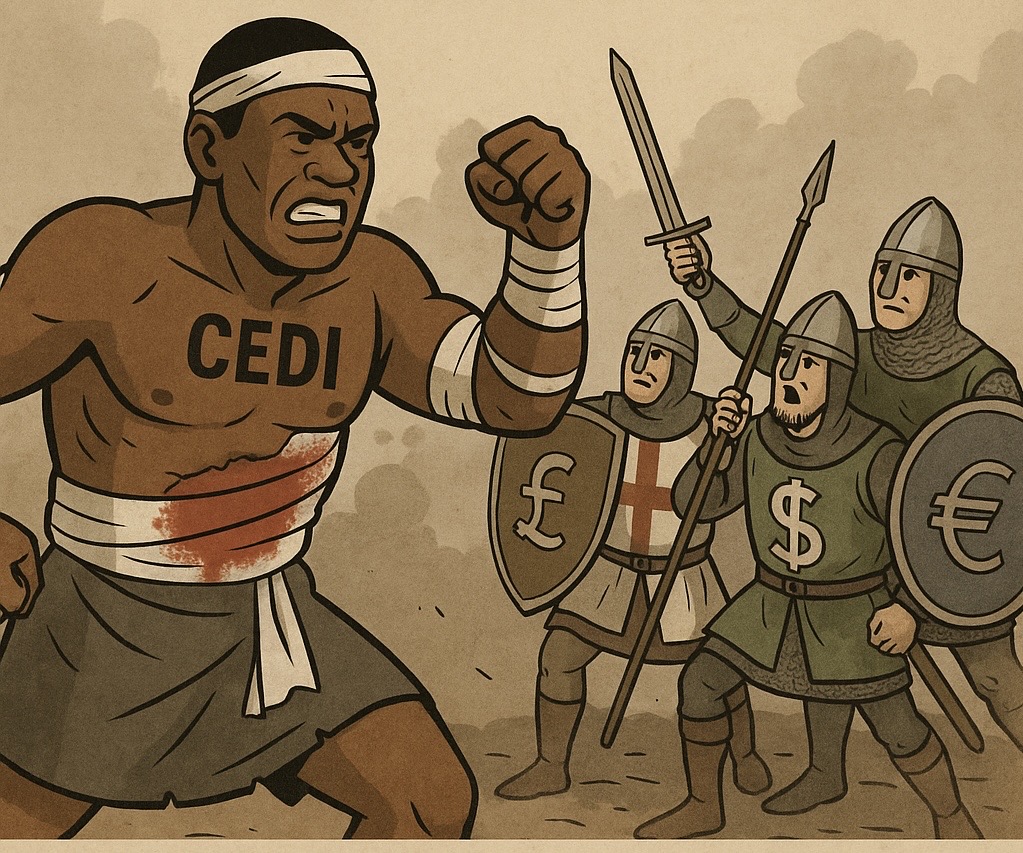
But the world is not a fair marketplace. The giants – DollarPound, and Euro – had been in the ring for centuries, bulging with the muscles of empire, trade, and industry. They had their networks, their soldiers, their standards, their debts. They did not just fight with fists; they fought with memories.

Cedi grew up in this world, always smaller, always hustling. Sometimes he rose with swagger, sometimes he fell with shame. He had seen coups and slogans, IMF infusions and debt write-offs, promises and disappointments. He had been bandaged, boosted, and broken more times than the crowd could count.

Yet the people of Agyakrom never gave up on him. Every election, they dressed him in a new uniform, gave him a new commander, and shouted, “This time, he will conquer!” The crowd’s memory was short, but their hope was long.

The arena itself was merciless. Every import, every school fee, every litre of fuel was another punch. Every cocoa harvest, every gold sale, every donor inflow was another jab back. Victories were rare, defeats were common, but the spectacle never ended.

The elders said:

“Sɛ anomaa anntu a, ɔbuada.”
(If the bird does not fly, it starves.)

Cedi might never soar like Dollar or Pound, but he had to perch somewhere sturdy – or risk falling forever.

This is the story of Cedi: a fighter wounded and revived, mocked and applauded, sprinting on borrowed steroids, and finally learning that his survival depends not on miracles but on habits. It is the story of Ghana’s economy, told in the dust and sweat of a ring where applause is loud but stomachs are louder.

The battle of Cedi is not just about exchange rates; it is about identity, resilience, and the stubborn hope of a people who refuse to stop cheering, even when their pockets are empty.

And so, the drums beat again. The giants tighten their gloves. The medics prepare their syringes. The Old Wise Man sharpens his proverbs. And the crowd leans forward, asking the eternal question:

“Can Cedi stand?”


Click to Read Episode One – The Fall of the Cedi